
BY SARAH NEEL ’28
The following article discusses themes that may be triggering for some readers. Please note the Keely and Du content warnings for more information.
This semester’s Black Box production, Keely and Du, written by Jane Martin and directed by Teisha Duncan, opened on October 17th. I attended the Saturday performance on October 18th over Celebration Weekend, and the lobby of the Janet Kinghorn-Bernhard Theater immediately had a different energy than other shows I’ve seen at Skidmore. The lobby presentation, curated by dramaturg Charlotte Ballantoni ’26, not only highlighted the rehearsal and dramaturgy process, but included resources on self-care and community safety for the audience. Immediately this exemplified the care and love put into this production by the cast and crew. It set the expectation that this production had no intention to shock or scare it’s audience, instead asking them to think critically about the themes presented while still taking care of themselves.
Immediately when entering the Black Box, the energy changed. The set, designed by Ella Theoharis ’26, completely redefined the usually comforting and consistent presence of the Black Box. No longer did I see a stage but a fully immersive basement, with the audience situated in a three-quarters positioning. The floor was a eerily familiar grey, resembling the average unfinished American basement. Several concrete poles stood in the middle, rising up to the wooden ceiling that covered the entire Black Box. To my left was a staircase leading up to the imagined rest of the house. I immediately began to wonder about the world of the play, whose basement we were in, and the set pieces cluttering the room, such as a rocking chair and sink. The world of the JKB disappeared, and I found myself entirely in the world of Keely and Du.
At some point while the audience is getting settled, Du, played by Lily Forbes ’26, descends the looming staircase into the world of the basement. In nurse’s attire, Du begins to make up the room, singing along to a song about a girl named Katy. Du’s actions are merely harmless, even seemingly comforting, but the cold basement and religious rhetoric allude to something more sinister at play.
A loud buzz shocks the room. The voice of Walter (Ben Harris ’27) asks if Du is ready. He descends down the stair, immediately handing Du a cartoonish superhero mask. Du is no longer a kind, older caretaker, but a part of something greater, and the presence of Walter looming on the staircase haunts the room.
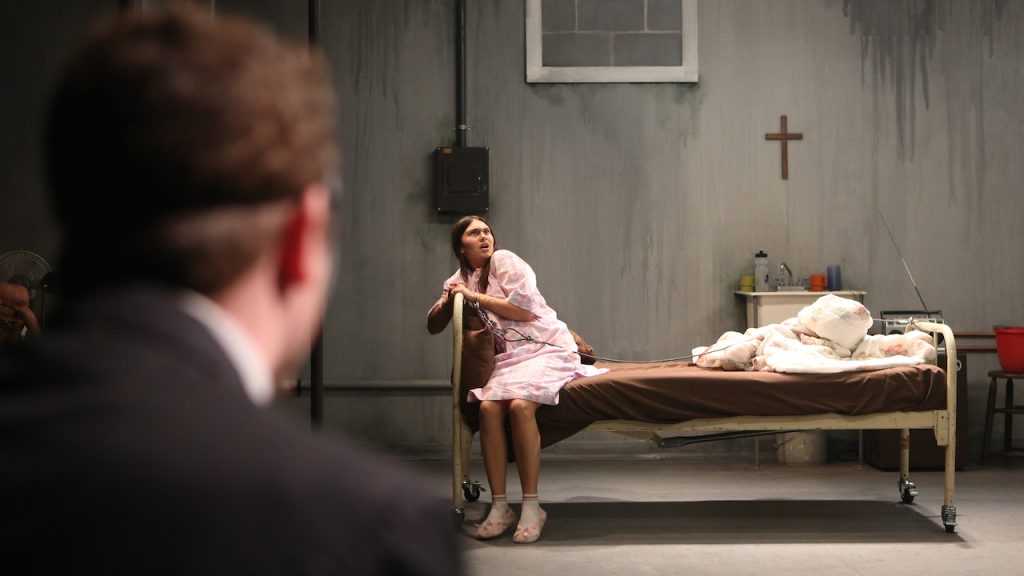
It feels like Du and Walter are holding their breath, and for good reason, as suddenly the unassuming filing cabinet in the stage left corner swings open to reveal a second door (an excellent set device created by Theoharis). Two orderlies (Gus Jacobellis ’29 and Nate McNabb ’29) come rushing through the hidden doorway, pushing in a hospital gurney with a drugged Keely (Emily Landolfi ’27) strapped to the bed. Being so immersed in the space the attention of the audience was immediately focused on the clearly kidnapped figure.
Walter promises Du that he will return in four days, her husband wishes her well, and that everything will go to plan. He leaves her with a final thought that God be with her, and that they will prevail.
Walter and the orderlies exist as Du goes to assess the victim. For the first time of many, the two women stand alone on stage – the titular relationship of the play. Du sits down, singing in the rocker, and lets Keely sleep. From the onset, the dichotomy of Du’s identity presents itself: Her simultaneous care for Keely coupled with the ominous and horrific crimes..
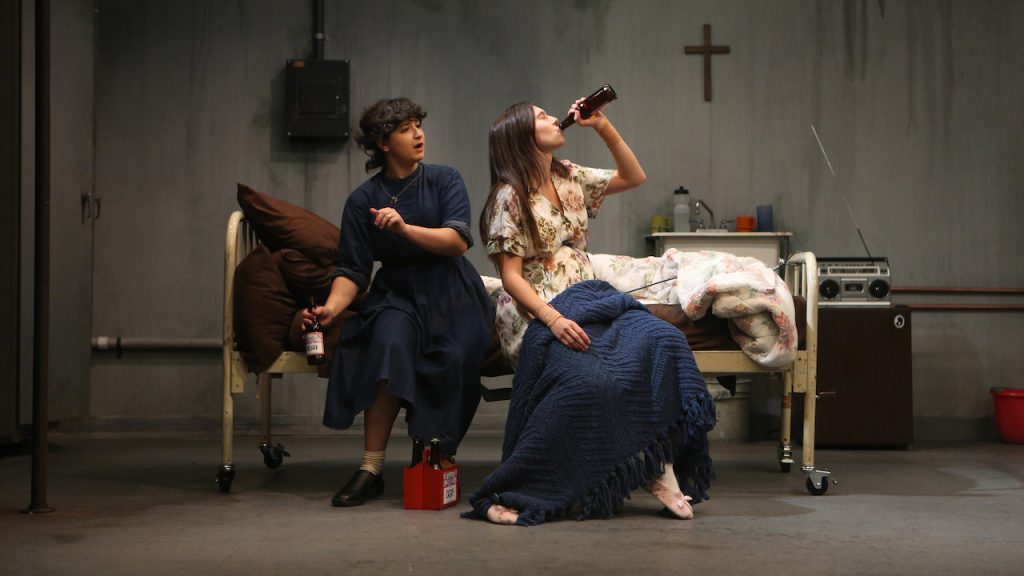
As the scenes transition, the lights, designed by Lillian Culver-Anderson ’26, fade to dark on a sleeping Keely. These transitions, which occur throughout the piece, were incredibly helpful as an audience member to understand the many months spent in the unchanging basement.
The momentum of the relationship between Du and Keely begins to take off as Keely awakes in the basement. First disarmed and perplexed, as Keely last remembers being outside the abortion clinic, Du sedates her easily, and then once noticing the restraints, all hell breaks loose. Keely begins to fight against the restrains placed on her, and reveals she is the sole caretaker of her father. There is no justice for her, only a shift of light, revealing time moves along without her. The empathy I felt was immediate, and the intensity of the situation was truly palpable.
The next few scenes document Keely and Du’s passing days together, with Du attempting to connect with Keely as Keely refuses. No matter Keely’s violent reaction, Du stays, watching over her and telling stories from her own life. Du’s monologue about her own children illustrates some of her motivations for her actions. Throughout this scenes I felt myself captivated by the staging, given one of the actors backs was turned from me at all times. It provided a greater sense of reality, that we truly were in this basement with these women, but also allowed me to focus on things I wouldn’t normally, like lighting choices and the reactions of the other characters.
In the next scene, Walter descends from the stairs, almost god-like, penetrating the space created by Du and Keely. Harris’s performance quickly jumps between almost warm, friendly, and caring to unleashed, rageful, and in control. After four days, Walter finally explains to Keely why she has been brought here: that him and Du are part of an anti-abortion group, hoping to make an example of Keely and three other young women by forcing them to keep their babies. Keely specifically was chosen as a rape victim as they believe all abortion is murder. As Walter returns back up to the outer world, Du aligns herself with Keely for the first time in saying “I’m sorry they chose you”, implying a very confusing moral conundrum as she is ok with the kidnapping yet empathizing with Keely. The two women being left in the basement by Walter also immediately felt to me like they had both been kidnapped, as Du is stuck with Keely just as much as Keely is stuck with Du.
Days later, Walter comes down again, significantly less youth pastor esque and more cult leader. He screams facts regarding unborn babies at Keely whilst spinning her bed around, leaving Keely powerless. Here Du pushes back against Walter, explaining that berating this young woman won’t convert her to their cause. In a way, this is also Du defending Keely, who continues to sit and watch over her from afar as they drift off to sleep. Forbes’s performance is never uncomplicated, but always rich with care, striking even in early moments in the play.
This seems to be an important jumping off moment in their relationship, as in the next scene, while still filled with animosity, Keely shares about her life, her father, and the assault that led to her abortion by her ex-husband, Cole. But even after Keely’s tirade on her beliefs, Du sits by her.
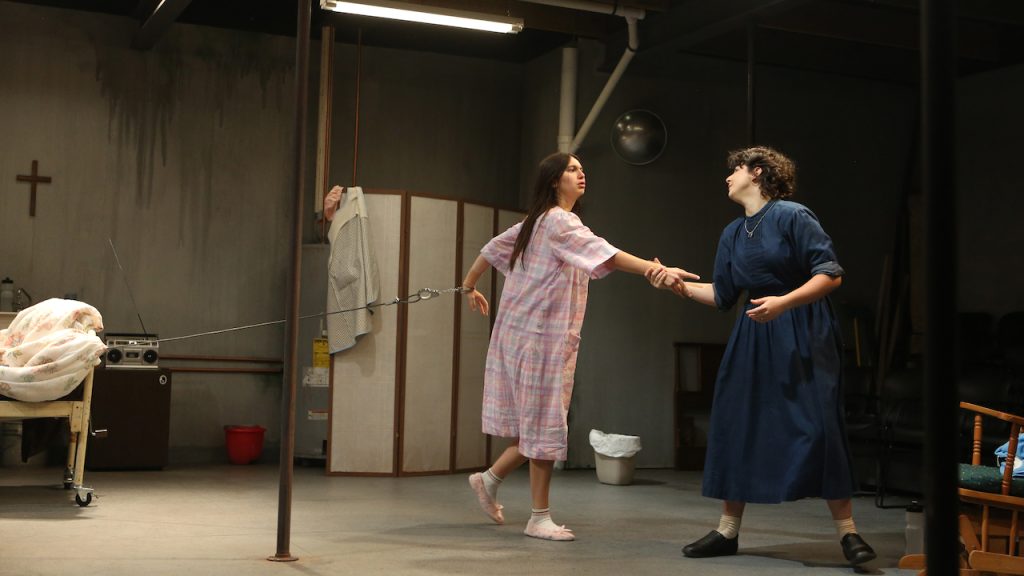
More days pass. The audience sits with Du and Keely as Walter tries to show pictures of the development of a fetus, as Keely finally asks for food. As an audience member I felt the passage of time weigh heavily, feeling more and more in Keely’s shoes being surrounded in the grey box for a prolonged period. This explains the begrudged yet developing friendship of Du and Keely, as Du begins to pry more into Keely’s life. Keely tells the story of how she and her ex-husband originally fell in love. A hilarious moment, played out earnestly and delightfully by Forbes, reveals that the near elderly Du is an active weed smoker (a rare moment of levity!). While Du tries to align herself with Keely, explaining her marriage isn’t perfect either, Keely pushes back with the devolving of her marriage with Cole: his increased alcoholism, financial struggles, her father being shot, and finally Cole hitting her, causing her to leave their marriage. After this however Cole refused to leave her alone, resulting in him raping her. And somehow, Du manages to defend him.
As a Theater major, something I’ve been ask to ponder many a time is “whose play is it?” — whose story is this play trying to tell? This was the question I had at the forefront of my mind when leaving the Black Box, especially leaving that final scene. The truth that I found was that no matter who in the play you agreed with, it was both Keely and Du’s story, centering the strange places empathy and kindness finds itself in.
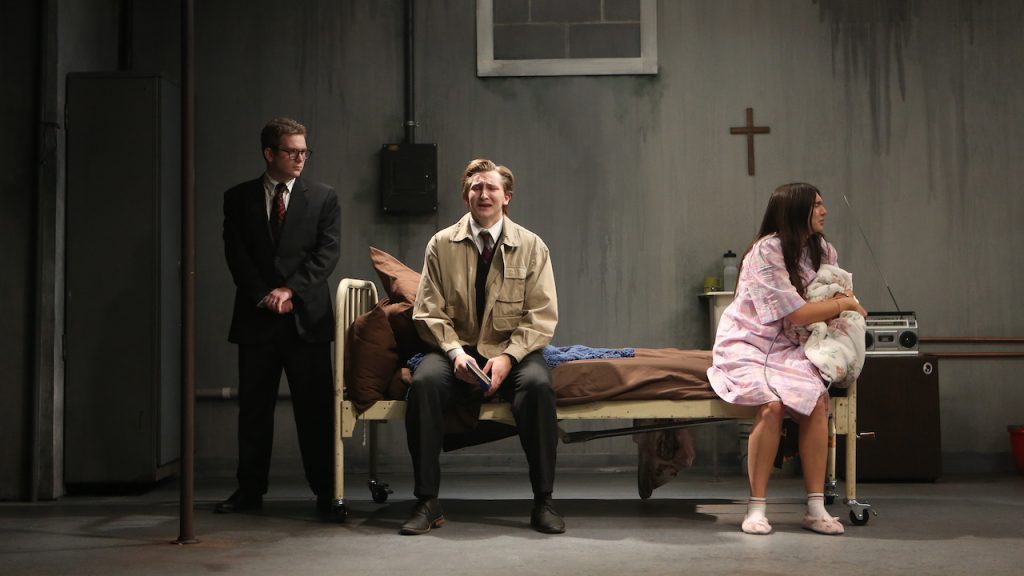
Photos by Sue Kessler
***
Sarah Neel ’28 is a staff writer for the Skidmore Theater Living Newsletter