
BY CHARLOTTE BALLANTONI ’26
On November 10th and 11th, the last Studio Lab of the semester, Grippy Sock Vacation by Beth Hyland, directed by Becca Durst ‘27, was performed. Before continuing, note that the play covers difficult themes including: mental health, suicide attempts and ideation, eating disorders, residential treatment, and parental issues. Please take care of yourself.
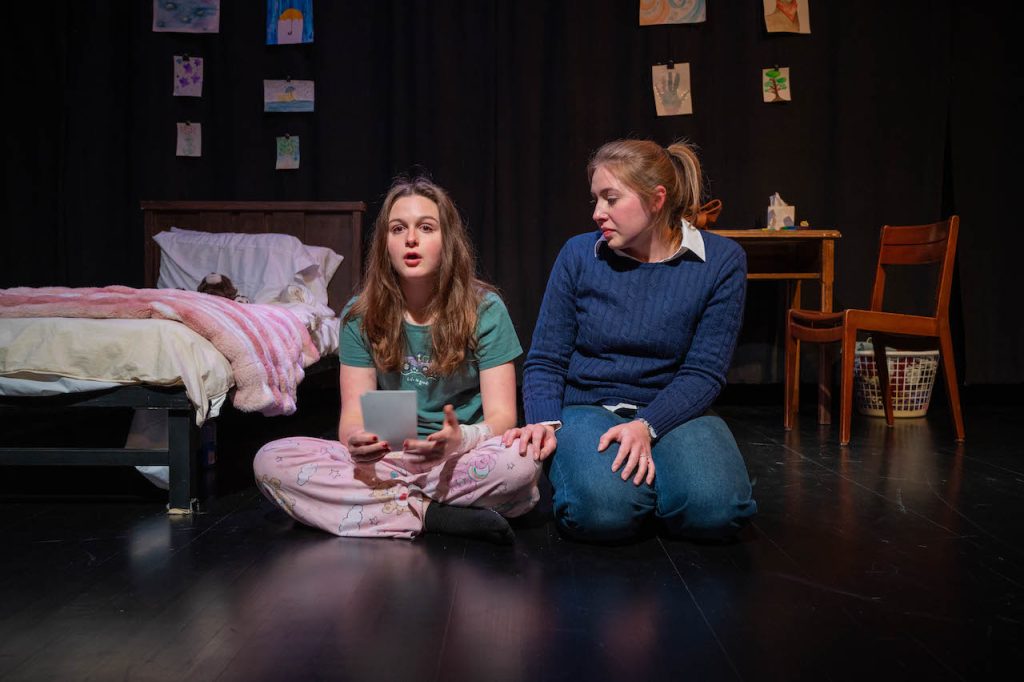
Walking into Studio A, I see Isabella (Grace Whitney ‘29) and Caroline (Lila Sandler ‘27) on stage. There’s an age difference — it’s later revealed that Isabella is ten years younger than Caroline. Isabella is younger, laying on a bed, wearing Care Bears pajamas, socks with grip on the bottom, and a bandaged wrist, and scrolling on her phone, homemade art on the walls. Juxtaposed against her is Caroline sitting at a desk, looking put together in business casual. She’s anxious, tapping her foot and checking on Isabella. On the bed, there’s a fluffy blanket and stuffed animal, attempting to make a sterile room homey. There’s no sound as the audience enters. As I’m watching, the conversations of the audience fill the space. Not including sound pre-show is a great choice by Durst — it forces audience members to experience the same awkward silence as the girls, their disconnected relationship on display immediately.
Once the play begins, Isabella asks Caroline to make a TikTok with her, and Caroline refuses. Isabella films a take of a dance, and Caroline attempts to connect with her. Sandler’s portrayal of Caroline feels authentic: she’s unsettled, but is trying to be supportive. Caroline calls Isabella’s room a “dorm room,” showing Caroline’s discomfort with treatment. Isabella tells Caroline about her roommate, using therapy language in a teenage way, expecting that Caroline will understand.
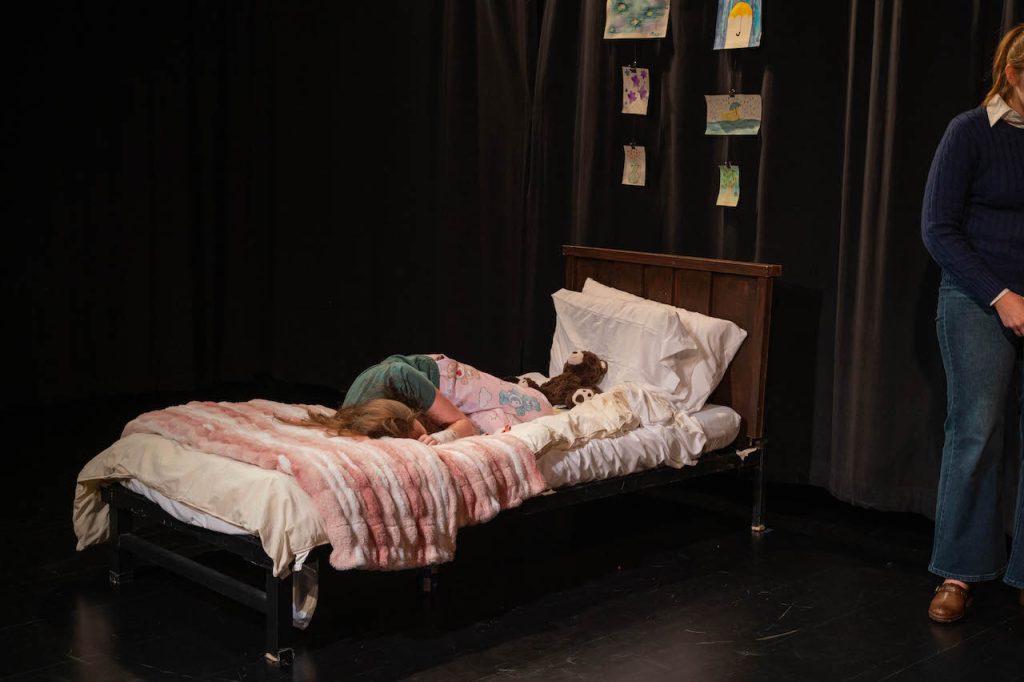
Isabella makes a comment about her roommate’s mother coming, sad that her own mother isn’t there. Caroline notices how nice the space is, and that it doesn’t feel like a mental hospital. The audience learns that Caroline is visiting Isabella in a treatment facility. Caroline whispers the words “mental hospital,” a funny portrayal from Sandler, and instead calls the facility “residential treatment,” or “a spa”.
Caroline is tense and Isabella is relaxed, demonstrating their opinions on mental health treatment. Isabella is lighthearted and laughs at the situation, unnerving Caroline. Caroline shares that Isabella’s therapist, Lara, gave her rules for speaking to her sister, and this loosens Caroline up, no longer afraid of messing up, but anxious about getting in trouble for telling her sister. We learn that Caroline is visiting Isabella as part of “Family Weekend.”
Caroline is confused by the residents having their phones and finally asks “are you okay with everyone knowing you’re here?” Isabella assuredly replies “why wouldn’t I be?” Caroline is shocked and appalled that Isabella is comfortable with her peers knowing she’s in treatment. At this moment, I was unsure if Whitney was acting — this character felt very natural.
Isabella tells Caroline that her therapist said that their mom has Borderline Personality Disorder. Caroline refuses this, stating “that’s like the way she is,” highlighting the differences in the sisters — one idolizing their mom, the other able to critique her. Isabella explains therapy jargon to Caroline, who is unable to understand. Caroline changes the subject and pulls out pictures, which she brought to help Isabella process, but Isabella is unreceptive.
Isabella is upset at their mother not coming to see her, to which Caroline gets upset, trying to show her sister that her actions impact others, and Isabella is continually laughing at the situation. The two sisters are in a stand off, Whitney giggling and Sandler staring at her.
Caroline explains that their mother finding Isabella after her suicide attempt has had an impact on her, and it was decided by the treatment team that their mother shouldn’t see Isabella. Caroline’s emotions heighten, yelling that she doesn’t know how to connect. After a moment, Caroline wants to understand, and Isabella shares what made her attempt. This makes Caroline cry, and she wishes Isabella would have told her. Isabella holds Caroline, an inversion of a standard dynamic: younger sister comforts older. This moment was artfully created by Durst.
The sisters speak, and Isabella tells Caroline about the mental health problems that have always been seen in the women in their family. Caroline is receptive until Isabella brings up Caroline’s eating disorder. Caroline cleans up the physical mess of pictures Isabella made, demonstrating how, as the older sister and eldest daughter, she’s always picking up the pieces. She tells Isabella about how much she loves her and has always loved her, saying “if you could see yourself how I see you I think it’d all be different.”
Caroline does the TikTok dance in an attempt to relate to her sister. Afterwards, Isabella understands how much her sister loves her and how important she is to others. There’s static, and then the curtains are drawn. The walls are covered in baby and childhood pictures, the past surrounding and confronting the sisters. However, they’re able to take on the past together. This connection and teamwork is shown in Durst’s direction, and I can’t help but feel proud of these women I’ve only seen for thirty minutes.
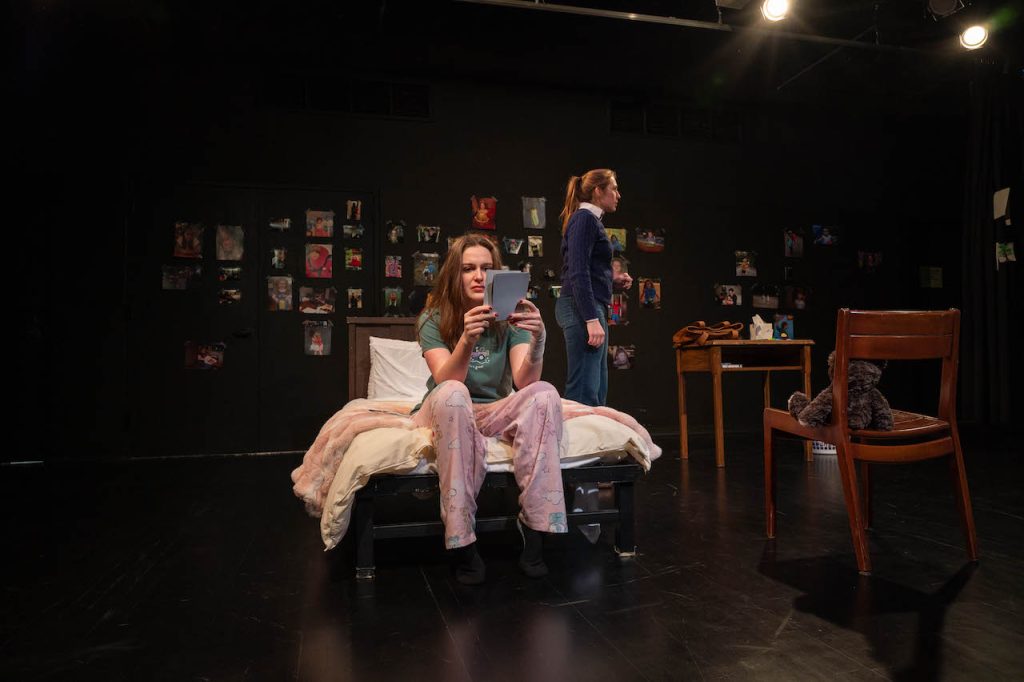
I wrote down around here how authentically sisterly Sandler and Whitney feel. They antagonize each other but they love each other regardless. Their ability to joke, fight, and make up make me long for the sister I never had.
Photos by Logan Waugh ’26
***
Charlotte Ballantoni ’26 is a staff writer for The Skidmore Theater Living Newsletter