
PLAYWRIGHTS LAB #3: VOICES BY MEGHAN WAX
posted on January 22nd, 2026 by klsimpsonBY KIT SIMPSON ’27
Voices by Meghan Wax ‘27, the semester’s third and final Studio Lab, played on September 30th and December 8th in Studio B.
Wax’s play opens on a familiar scene – a busy street. As our protagonist Lauryn (Anna Statlari ‘28) crosses the road, the voices in her head ask her if she looked both ways. Her overthinking on the matter causes her to stop mid-crosswalk, resulting in cars honking at her for holding her up. The voices chastise her, reminding her that she caused the cars beeping at her.
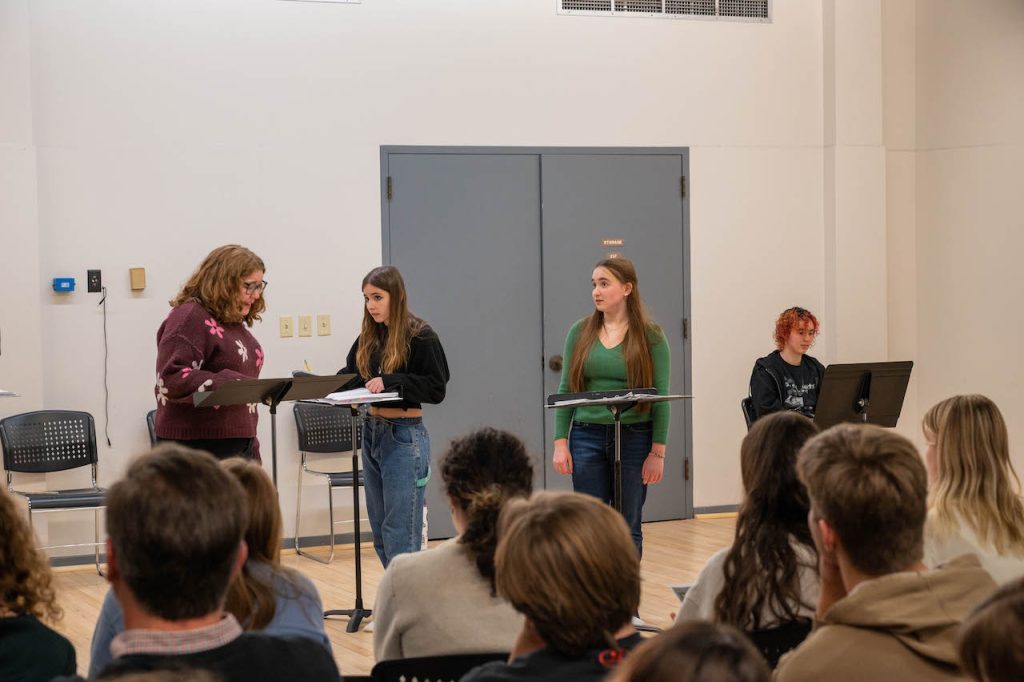
After her kerfuffle on the road, we next see Lauryn entering her first day of art class. She’s running late, and so she finds herself sitting next to stranger Quinn (Daniella Solomon ‘29), which, again, her voices make fun of her for, especially as they realize that Quinn is talking to her. It is here that we get some exposition on Lauryn; she’s a teacher by day with a desire to be an author, but an extreme fear of showing anyone her work. She wants to become a better illustrator. Quinn stays especially tight-lipped about her own past, and we learn very little about her in this moment, beyond that she self-describes her job as being “an observer.” Lauryn believes Quinn to be something of an odd duck, but she ultimately seems to engage with them, because, as her voices incessantly remind her, she leads an incredibly lonely life.
A specific choice of Wax’s that I loved was her decision to use Lauryn’s voices as the ensemble, building out public scenes with their presence. This especially works well in scenes in the art classroom, where we can see some students absentmindedly doodling while also chastising Lauryn. In a sense, this feels very reminiscent of what actual experiences having anxiety can feel like – as Lauryn’s thoughts overwhelm her, so too do her surroundings. The voices also function well simultaneously as a hivemind and having their own distinct personalities — Lucia Cicerchia ’28 as Voice 3 was a particular gem to me.
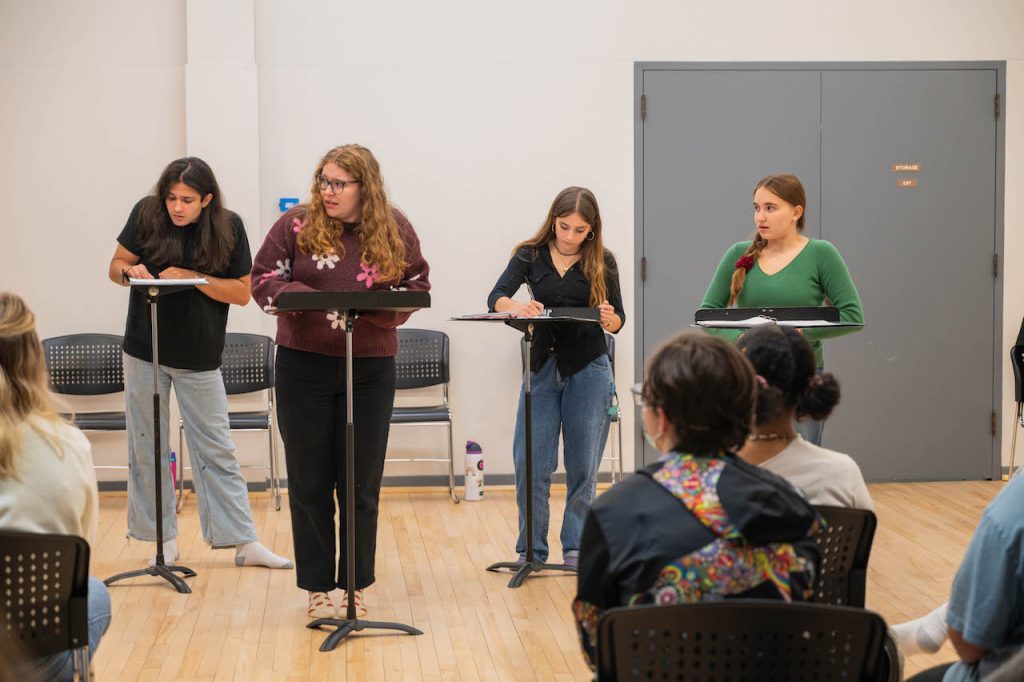
Wax also does excellent work representing the repetitive nature of anxious thoughts – in scene three, as we watch Lauryn leave her apartment, for instance, we see her stress about turning the oven off as her voices ask her again and again if she is 100% certain that she actually turned the oven off. Wax did excellent work dramatizing such feelings while still allowing it to feel grounded – I’m sure many people can relate Lauryn’s fears over the course of the play. Take, for instance, when, in a later scene, Lauryn convinces herself that she’s misspelled dessert on a board in front of all of her students, and her voices berate her for this, pointing Staltari did excellent work portraying. Staltari managed to have excellent chemistry with the voices in her head, especially in representing the push and pull that comes with both being frustrated by and following the commands of one’s anxiety.
Quinn’s primary purpose in the story is to help Lauryn get over her extreme anxieties. Her primary methodology for doing so is by giving Lauryn a journal wherein she can write down her fears – for instance, that she is afraid of trusting herself, or that she is afraid of saying the wrong thing.
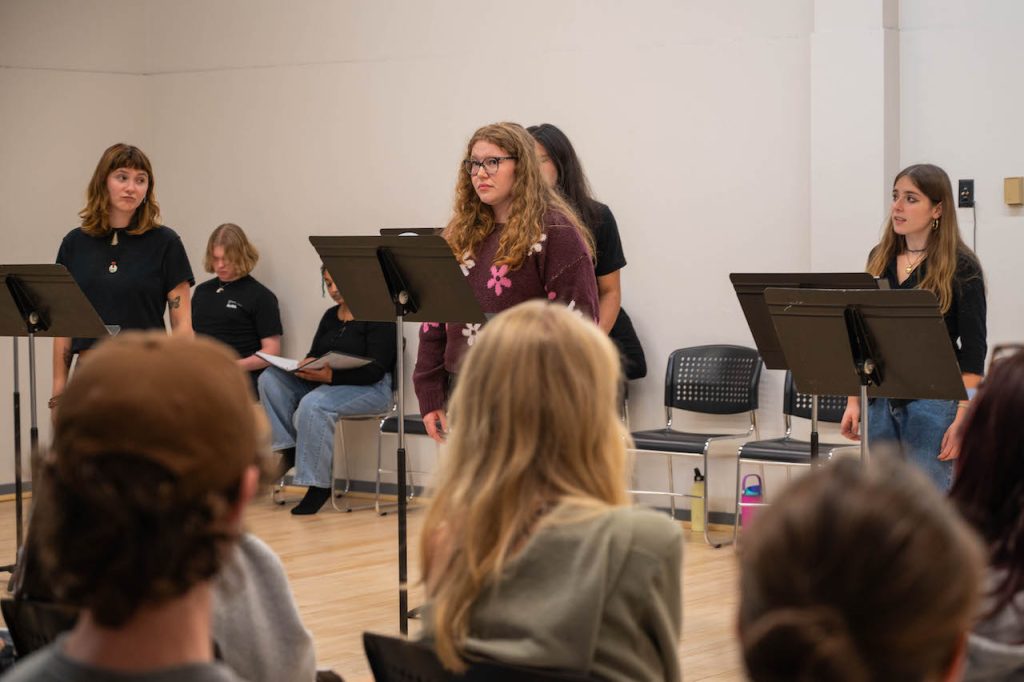
After Lauryn writes down these fears, she presents them to Quinn. Quinn then ushers Lauryn on supernatural journeys – wherein Lauryn gains brief abilities to breathe underwater or fly. These moments read almost as metaphors; Lauryn, is briefly, given the strength to do the impossible, which, in turn, seems to illuminate Lauryn’s ability to do things she previously deemed impossible, even if it’s just simply “crossing the road without thinking about it for thirty minutes beforehand.”
Eventually, because of Quinn’s magical therapy sessions, Lauryn is able to overcome her fears, and eventually submits her very own manuscript – which even gets published! However, when she goes to tell Quinn the good news, Quinn is nowhere to be seen. It leads the audience (and Lauryn) to wonder if Quinn ever actually existed, or if it was just a figment of her imagination. In the end, Lauryn does still hear the voices, but she is able to tune them out when she knows that they’re being unhelpful. However, she also knows to listen to them when they’re being reasonable – because of this, Voices had a distinctly hopeful tone that I very much appreciated. Wax did wonderful work in exploring what can happen when one learns to work both and against their anxiety; stories like Wax’s are ones that are incredibly important to hear.
Photos by Logan Waugh
***
Kit Simpson ’27 is the Editor-in-Chief of the Skidmore Theater Living Newsletter