
BY FINN KROL ’27
Last semester, newsletter writer Finn Krol ’27 sat down with new faculty member Sara Lyons to discuss directing, as well as Sara’s work on The Trees, the forthcoming Mainstage. Below is a transcription of their conversation:
Finn Krol (FK): What’s your favorite play and why?
Sara Lyons (SL): This question is insane.
FK and SL laugh.
SL: I have been agonizing over this a little bit, and I think, honestly, this is not a cop out, but the answer is whatever I’m working on at a given moment, because part of my job is to fall in love with whatever it is that I’m working on, and like, love is attention, right?
FK: Mhm, yeah.
SL: I pay such close attention to whatever play I’m directing at the time that I’m doing it. That’s all that exists. And beyond that, it’s such a complicated question. So I think that’s my answer.
FK: Hehe. Okay. Heard! What excites you about working at Skidmore?
SL: It’s so exciting working here. I do a lot of experimental theater and generative work as a director, and I’m really interested in interdisciplinary work. Specifically, interdisciplinary theater, working with non-actors, working with media artists and musicians, and just theater that maybe doesn’t look like theater in the ways that we tend to expect. Skidmore is the kind of place that really fosters that kind of thinking. I’m really excited to teach my first FYE eventually and gett to know folks in other departments as well. I’m really excited about what that will mean for the theater that I get to make here.
FK: Word. Yeah. That’s so exciting. I was actually just researching some of your previous work, which you’ve said was more generative. And I noticed that you’re drawn to more experimental types of theater. Can you tell us a little bit more about that? I was reading your website and then I realized I don’t actually know what this is, but it sounds really cool. Can you shed some light? Because it sounds awesome.
SL: So, in addition to a zillion years of theater education, I also have a bachelor’s degree in gender & women’s studies. And that has informed my work massively. When I started taking those classes when I was in college, that is when I decided to become a director and stopped focusing on acting. That education is all about understanding and analyzing how power structures work and the consequences of those structures for human beings. I found it really powerful to think about theater in that way. When I am leading a project, I have the opportunity to decide what is important, what has meaning for the period of time that an audience is in a theater with the actors, right? Which, is like a superpower.
FK: Yeah, that totally is a superpower.
SL: It’s a superpower!
FK: Yeah. I was reading a summary of one of your projects where the audience was involved and it served to – not literally – flip the script about what it is to make theater and how it impacts people. And that was really interesting to me.
SL: I’m really interested in work where we are acknowledging that we are all in a room together and not just disappearing behind the fourth wall and into the world of the play. I mean, I like that kind of theater too, to be clear. I just want to be precise about when and why we’re choosing to do that versus when and why we’re choosing to do something else. I try not to make any assumptions about, like, the right way to do a certain project or tell a certain story, right? Form follows content, you know?
FK: Yeah.
SL: So, yeah. I take that very common phrase really far.
FK: That’s actually the first time I’ve ever heard that phrase.
SL: Okay, great. Let’s talk about it!
FK: Yeah, what is that?
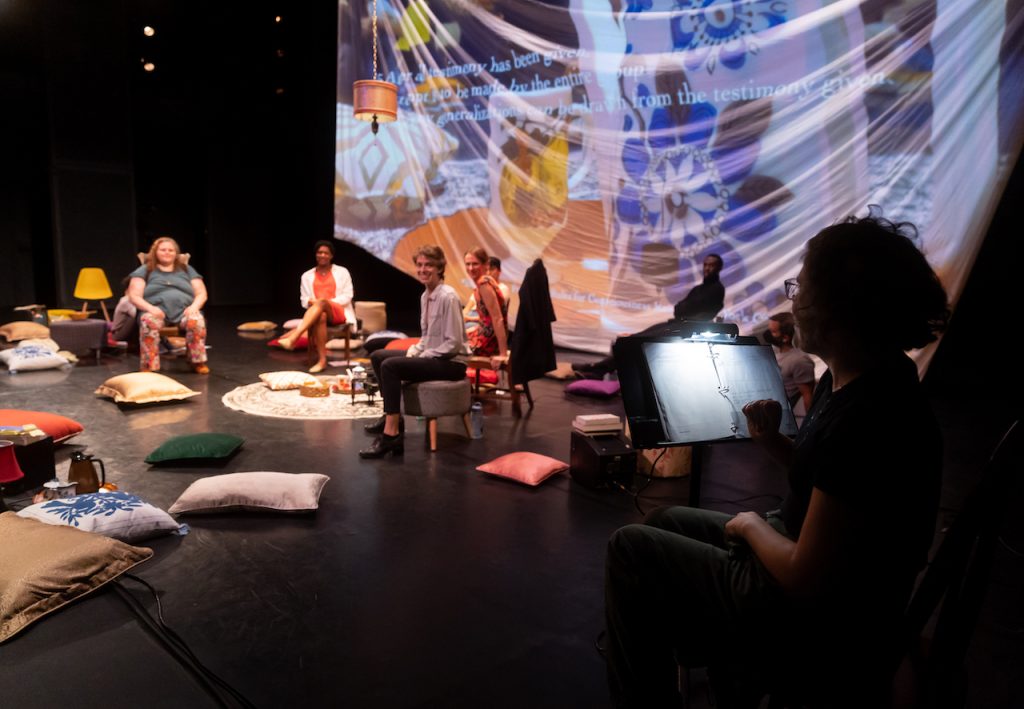
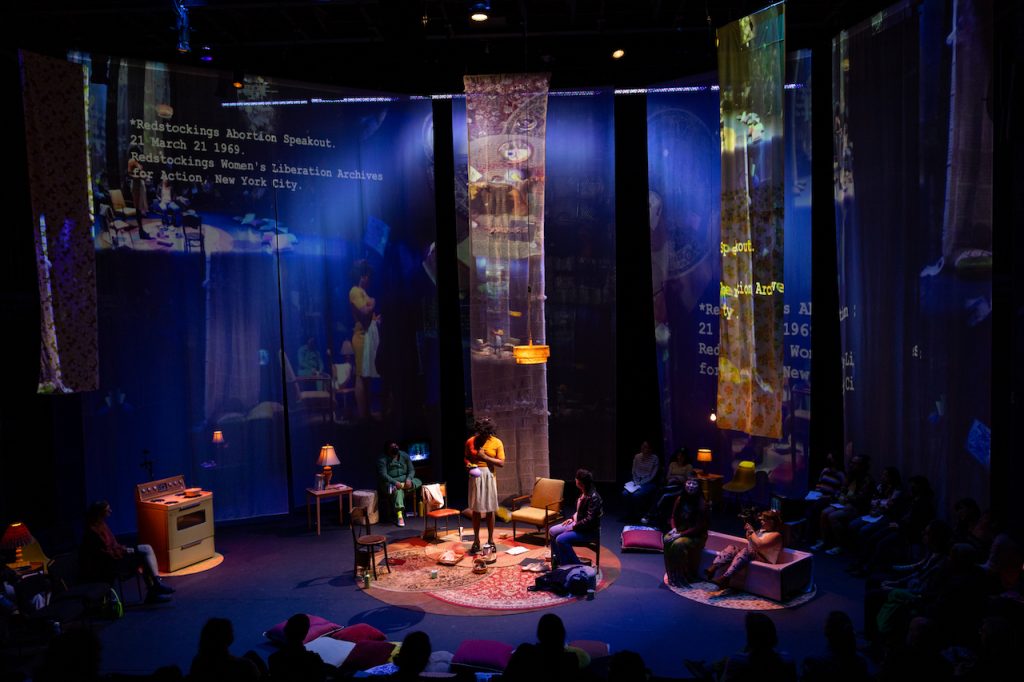
SL: I mean, especially, I think for you as a playwright it’s something to think about. Basically, it means that the choices you make about the form of how a story is delivered should be informed by the central questions or the content of what you’re asking. For example, the piece that you mentioned is called This Emancipation Thing – it has a lot of audience participation in it, and it is based on archival documents of feminist activists in the 60’s and 70’s, getting together and talking about their personal experiences around different feminist issues. The question that I had in that piece was “what use is this tool for us now?” Like, what might this history mean to us now? Do we want to carry this technique forward in activism? And so, the form that follows naturally to me, based on that question is, “let’s get the audience involved in actually doing it and see what happens.” So that’s an example.
FK: Thanks! That totally makes sense to me now. Next, how do you want to grow as an artist here at Skidmore in this next chapter?
SL: I’m really excited about continuing to develop this crazy practice that I have where no two shows are alike. I kind of start at square one with every new process. I’m excited about eventually bringing Skidmore students into that process. In this moment in the world, I feel the most hope when I am getting to work with young people, and so I’m interested in that really coming into my professional work that goes beyond Skidmore too. Super excited about that. I’m just excited to have this as a home base for my weird thinking, you know?
FK: Keep Skidmore Theater weird!
SL: Exactly. Keeping it weird. Making it weirder, actually. That’s the goal.
FK: That’s awesome. I’m stealing that. Making it weirder. More out of the box.
SL: What’s the box? Box. I’ve never heard of a box.
FK: Boxes? I hate those.
Finn and Sara laugh over each other.
FK: Speaking of words, (still laughing) sorry, this made me happy— Speaking of work at Skidmore, you’re directing The Trees.
SL: Yeah!
FK: Your first show here! Can you tell us a little bit more about the show and what drew you to it? And if you’re willing, some of your beginning concept ideas?
SL: This is a play that I love. It’s by Agnes Borinsky who’s a really amazing contemporary, trans experimental playwright. She’s someone who, like me, I think, is really interested in pushing the boundaries of what counts as theater AND, also, The Trees is a “play-type play.” A lot of her other work takes the form of workshops or books or events that happen which then get sort of integrated into storytelling, in performance. I feel like she and I share some brain cells in that way, which is exciting. This is a play that starts with a very theatrical proposal, which is that a brother and sister reunite at their childhood home and fall asleep in the grass and wake up and find that their feet have turned into roots and they’ve turned into trees in the front yard of their childhood home. Then the play follows them for seven years as new and unusual communities form and sort of change and evolve around them. It’s such a theatrical proposal because it’s just saying “here is something totally out of the realm of reality that just happens and we don’t need to explain it. It’s a thought experiment – like what might happen if this occurred?” But even though the play is not realistic in that way, there is something about it, I think, that is real in that it’s asking questions about our relationships to land and family and how those things evolve. With this one in particular, I think, it ultimately ends up really being a play about climate change and capitalism and what it would mean to really decide to be rooted in one place, which is not something that is valued as much in our culture, in our society now. We’re very globalized.
FK: Yeah.
SL: We’re very online, we’re flying all the time, and all of that has an impact on climate and also how we relate to each other. It’s a really beautiful and very gentle but powerful proposal for another way to experience the world. It’s also super queer, but it’s not full of trauma, and it can be hard to find that combination in a play.
FK: So true. Yay!
SL: Yeah, and it’s not really about queerness necessarily, but it is a very queer way of understanding the world and understanding land. I think it has such great opportunities for actors and designers too, because it’s such a strange theatrical proposal.
FK: Yeah. It feels almost like fantasy?
SL: A little bit. A little.
FK: Maybe that’s how I’m perceiving it right now before having read it, but your description is reminding me of M.J. Kaufman’s Saggitaturius Ponderosa, which also has a tree and some magical elements to it.
SL: Yeah, definitely like the same sort of generation of trans playwrights, you know?
FK: Yeah! Maybe there’s a genre there.
SL: For sure.
FK: Cool. That’s so exciting. And to close out our interview and to look super far ahead, Advanced Directing is coming most likely in Fall 2026. What are you thinking you’re going to cover?
SL: I’m so glad you asked, because I’m so excited to develop this class and create my version of it. I want people to take it! So register for Intermediate Directing so that you have the prerequisite for Advanced in the fall!
FK: I’m registered for Intermediate!
SL: I’m very excited to have you in that class! So, in Advanced Directing, we’re going to build on the script analysis, staging, and collaboration skills that I’m teaching in Introduction and Intermediate Directing. And we’re going to put those to work in much more contemporary and interdisciplinary forms of theater. I want to explore things like staging with live media and what does that look like? What does that mean? Exploring post-dramatic or non-narrative forms of theater, maybe exploring some social engagement or interdisciplinary work with music or dance. We’re going to be looking at the very cutting edge of what theater is doing now. The directors in that class will have the opportunity to start to develop a very individual point of view in their work, and get some important contemporary skills under their belts when it comes to working both within and beyond narrative storytelling.
FK: Awesome. That’s not what I expected at all, and that’s so exciting.
SL: Yeah, if you’re interested in contemporary theater, experimental theater, if you’re interested in devising and developing your own work, and also, if you’re interested in really deepening collaboration and collaborative skills, particularly with designers, I think that that will be the class for you.
FK: Gotcha. Cool. Awesome. Thank you so much.
SL: Thank you. This was fun!
FK: Yeah! Totally.
***
Finn Krol ’27 is a staff writer for the Skidmore Theater Living Newsletter