
FALL ’26 MAINSTAGE: BECKETT: NOTHING IS CERTAIN
posted on November 17th, 2026 by klsimpsonBY EM WILLIAMS ’28
A street lamp—the sole source of light—behind a translucent screen pulled the audience into Skidmore Theater’s Fall 2026 Mainstage like a moth to a flame—curious and weary of the unknown.
BECKETT: Nothing Is Certain, a collection of short plays written by Samuel Beckett and directed by Jared Klein, brought forth an evening of Beckett’s work to the Janet Kinghorn Bernhard Theater from October 23-28. Over the course of seven short plays, Act without Words I & II, Rough for Theatre I & II, Quad, What Where and Rockaby, the production transported the audience into select moments as well as exercises that challenged the mind to decipher meaning with only the direction of a disembodied voice and text projected onto the stage’s screen.
Unlike other pieces performed at the JKB, the production called on the crew as much as the cast to play an integral role in situating Beckett’s tone and conceptualized structure. Each person moved linearly, a strict pattern when beginning and ending every play. Some actors were wheeled in, while others moved in a calculated line—creating a sense of uncertainty in even how they played into the choreography they performed. It was almost like a simulation; something to be tested in a lab setting with precision.
The tone and mood was also molded around the set, costume, and sound design. There was little to no color in the costumes outside Quad, which had the players wear colorful caps and silver robes, and the set design stayed within a similar vein with grays, whites, and off-whites controlling the performance’s mood. Through costume designer Alicia Austin’s simplistic yet representational wardrobing and paint charge Jess Goerold’s design detail of the just illegible text covering the floor of the stage, the scene set before the audience became uncertain in all facets. Most of all, the sound, designed by Adam Tinkle, combined with the arrangement with Concord Theatricals on behalf of Samuel French, Inc. and the eerie instrumental pieces composed of erratic noise and whistling, elicited a psychological nightmare in the mind. Elements of the sound felt thrilling like a horror film, while others portrayed mystery and intrigue. It was a well-thought out sensory overcalibration that contributed to the audience’s exposure to certainty within narration and uncertainty within what emotions should be inflicted on the self while viewing each play.
In addition to narrative and emotional certainty, Beckett’s shorts had zero plot. It was without plot that the audience had to construct their own meaning within the elements that remain, and in some shorts, even dialogue was stripped away. Act without Words I & II and Quad asked the audience to rely only on their eyes to piece together fragments of meaning into a coherent message.
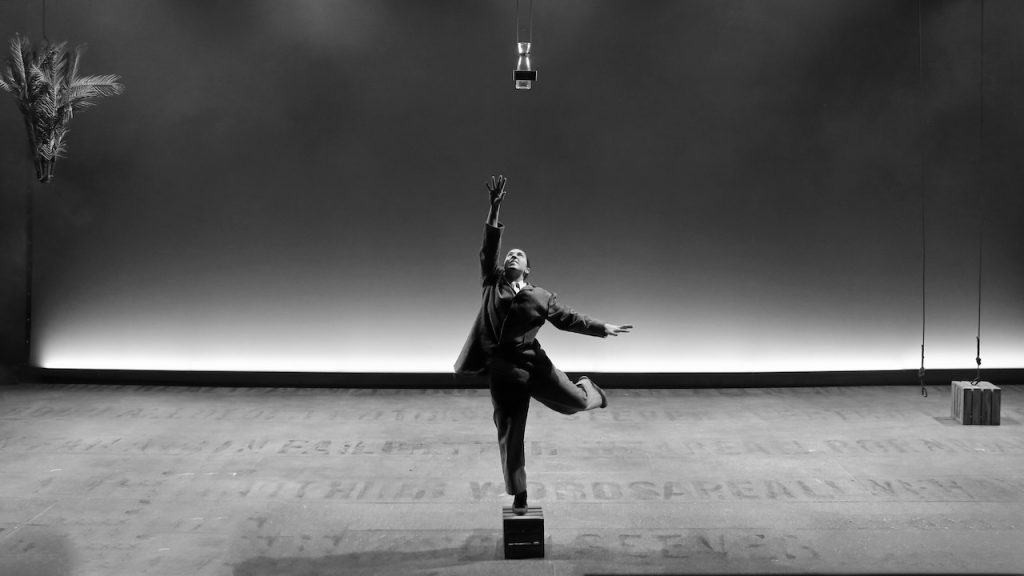
Act without Words I depicted an endless cycle of hopeless lethargy where sustenance and reward were held just out of reach. The deserted person (Asher Cortés ‘27) dressed in business attire alluded to the working class’ mistreatment and work ethic. It is expected for humans to search, problem solve, and achieve; but, when that achievement arrives, there is nothing. What remains are empty promises as portrayed by the incessant whistle beckoning the deserted person with rewards just out of reach.
Act without Words II built on this cycle of lethargy with the portrayal of two sacks on a conveyor belt, performing their individual routines and then returning to their sacks to begin anew. Accompanying their routines, a physical countdown was pictured on a television screen depicting the time left in each sack’s day. “A” (Audrey Tignor ‘27) expressed clear exhaustion and banalism with the world in which they existed. Tignor’s sluggish movements, frustration at small tasks, and solemn demeanor were a perfect trio of pessimism to convey the depression present in the modern world. “B” (Ken Caron-Quinn ‘27), on the other hand, illustrated a sort of aloofness with the endless cycle and appeared to welcome each new day within their existence. However, it was Caron-Quinn’s brisk movements and precision that made what would be the opposite of Tignor’s pessimism—optimism—appear more as a blissful ignorance of the monotonous cycle. Both of these approaches signaled a greater issue of hopelessness as both sacks remained trapped in this routine, and with no way to step off the conveyor belt, they were to remain within the cycle eternally.
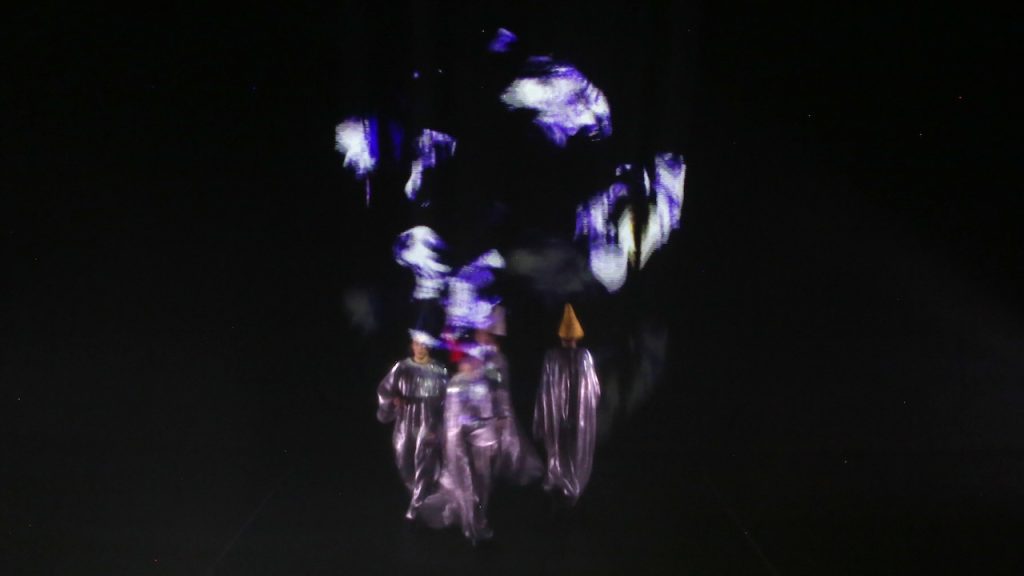
As for Quad, the four actors (Asher Cortés ‘27, Emily Landolfi ‘27, Eleonora Catalano ‘29, and Percy Fowler Perlaza ‘29) simulated a cycle that repeated in fours with each new cycle getting more erratic, rapid, and brisk. It felt as if within the square, each time a cycle completed, the actors were one step closer to self-liberation. The group began stoic and linear—on task—but as the demonstration sped up, different personalities and variations in gesture occurred in each actor, while still cycling around the square in the same pattern of movement. The screen projection also slowly morphed from undistinguishable figures in a grid to a surveillance of the four individuals in the quad. This felt representative of how insignificant humans are as a unit being tasked to cycle around as a body rather than a person, but as individuals with their own distinctions, they can finally be perceived as their own identity and break the cycle of control.
The remaining four shorts utilized dialogue to orient the scenes; however, akin to the previous grouping, each piece illustrated its dialogue to fit a specific, and often different, purpose. Rough for Theatre I & II analyzed how two parties congregate in order to reach a solution, while What Where and Rockaby focused on propelling a cycle until there was nothing left to grasp, or no more answers to be given.
To examine chronologically, Rough for Theatre II saw Bureaucrat A (Alyssa Galen ‘27) and Bureaucrat B (Lila Sandler ‘27) review and determine the fate of person C (Sophia Connell ‘30) who stood on a ledge with their eyes cast on the same television screen seen in Act without Words II. Throughout the scene, Galen and Sandler mirrored each other’s movements while methodically recollecting the documents on person C. There was no dialogue from Connell, only expression in their projected eyes, which would quickly shift from anger to fear to sadness throughout Bureaucrats A and B’s conversation. The two Bureaucrats also appeared exhausted and distressed, demonstrating a sense of apathy to the nature of deciding the life or death of another individual. Additionally, when moving in proximity to one another their behavior and body language also contained apathy, feeling disjointed and linear rather than human and imperfect.
In the end, the bureaucrats became restless and intrigued by the presence of the bird cage, which contained one dead bird and one alive bird, and turned towards person C with a match. The concept of the dead and alive birds felt as if Beckett was inferring that the caged birds did not receive equal care or that the Bureaucrats did not hold equal responsibility for the birds’ lives, leaving one of them to die. This idea may indicate the injustice of the system to equally treat each individual under the law or maybe it could be that those who work in the justice industry tire themselves under the pressure to give each case an equal chance to thrive.
In comparison, the later presented Rough for Theatre I featured two players with two different disabilities, “A” (Audrey Tignor ‘27)—a blind person who played a fiddle and “B” (Ken Caron-Quinn ‘27)—a wheelchair user who aided their ability to move themselves with a cane. The two characters found each other in a vacant space with the hope that they could co-exist and aid each other through sight and mobility. Scenically, the players were contained under a bright, rectangular, overhead piece that in part illustrated the limitations of the space and its actors, as well as the illumination of their disabilities in society. Both “A” and “B” pointed out in one instance or another ignorant comments about what the other is capable and incapable of accomplishing, which depicted how hardship does not necessarily make one sensitive to the struggles of another person.
Though they came to a consensus on how they could guide one another, giving them strength in what they did not possess—sight or mobility—they inevitably came to a disagreement that could no longer bond them. As Tignor tore away the cane from Caron-Quinn, both individuals were disconnected and isolated again. As an able-bodied person, I cannot comment on the accuracy of Caron-Quinn and Tignor’s portrayals; however, it was clear there was time and consideration put into the sensitivity of the topic, and they both complemented their characters’ societal isolation with great emotional beats.
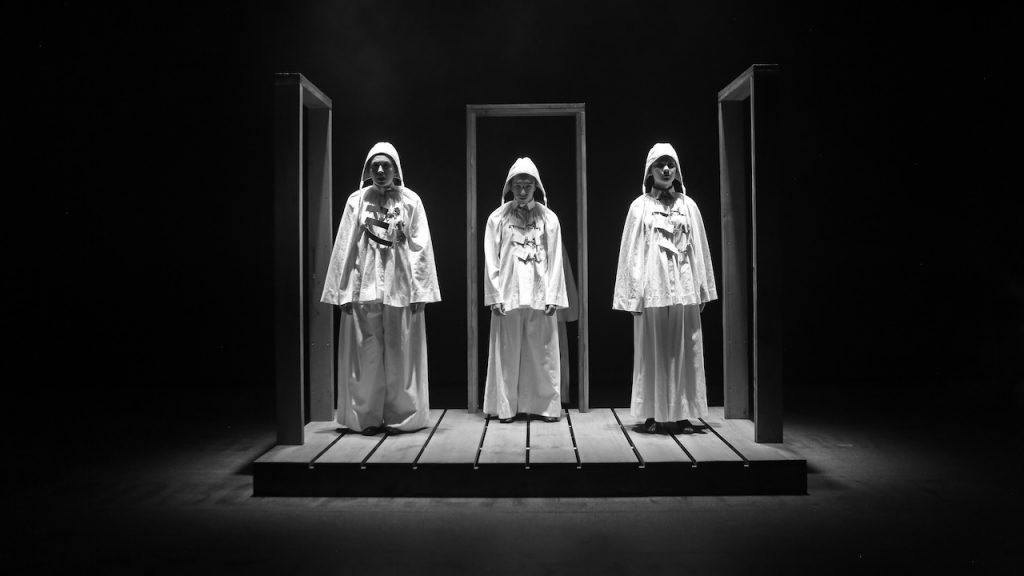
What Where presented a different system in comparison to the other shorts of Beckett’s with cycles. In this performance, V (Sophia Connell ‘30) provided the story of Bam (Lila Sandler ‘27), interrogating Bem (Alyssa Galen ‘27), Bim (Eleonora Catalano ‘29), and Bom (Percy Fowler Perlaza ‘29) to find someone to blame and condemn. For every person questioned and for every time the simulated dialogue appeared to elicit the incorrect response, V asked the integration to begin again. Furthermore, in the beginning of the simulation V explained that “we are the last five,” which could infer that the audience had only caught the tail-end of this cycle of blame. In each integration, time passed and the eventual solution turned the one who condemned others into someone who became condemned.
Even with strict affirmatives from the accused, without any other answers, Bem, Bim, and Bom were all eventually condemned and imprisoned until they could admit their guilt. Then, Bam was left alone with no more answers given and so many more questions that cannot be sought. The cycle of blame brought forth the idea of morality and the self’s purpose to purify themselves from ill-will. Every individual wants to believe they are morally good and acceptable, but by that motion, they are left to condemn every sworn person around them to seek answers they will never find.
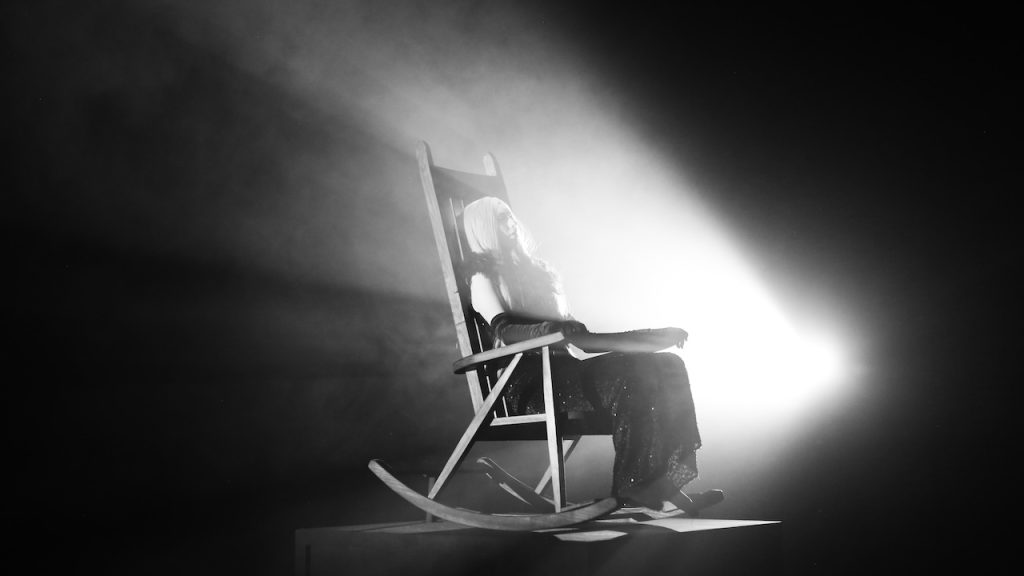
Finally, Rockaby closed Beckett’s shorts of uncertainty with the inevitability of death. Among all the plays, this scene was the most visually certain but also the most conceptually uncertain. Visually, the woman (Emily Landolfi ‘27) depicted on the rocking chair (rocked by Percy Fowler Perlaza ‘29) had reached the near end of her life, replaying her final thoughts as she rocked back and forth in front of the sunrise. Her final words prayed for more time to appreciate the life she had lived and mourn the world she must leave. However, the conceptual uncertainty lied in what it feels like to exist on the edge of death. A person can not recount the experience of their death as they no longer live, so as the woman gasped for breath, begging for “more,” there was uncertainty in the character in terms of where their fate would lead them on the other side. It was when the woman’s life ended that the rocking chair stopped, indicating the end of her life and its cycle of existence.
Leaving the JKB after the final bow, I initially felt that Beckett: Nothing Is Certain had left me with as much certainty as I had when I had first sat down in the front row—which was zero. However, it had eventually crossed my mind that our existence as people is uncertain. In every new venture, we begin in an unknown of our own making, and it is our responsibility to navigate ourselves through nothing into creating a sense of something. Even though “nothing is certain” in this production, the audience only observed the players in one instance of the endless cycles they inhabit, which left room for other possible cycles in which they found a solution or meaning within the banality, uncertainty, or disillusionment of their own existence. And, in reality, the obstacles we, as humans, cross in life will not always mean something or have a reason for which they exist; but, it is what we do with the new unknown in our lives that allows at least some certainty to peak through and a sense of acceptance to overcome what we will never know.
Photos by Sue Kessler
***
Em Williams ’28 is a staff writer for the Skidmore Theater Living Newsletter