
BY: KIT SIMPSON ’27
Visiting Lecturer of Playwriting Gen Simon’s Bloom Bloom Pow, directed by Lu Glassberg ‘26, was performed in the Janet Kinghorn Bernhard Theater’s Black Box from February 27th to March 4th, 2026.
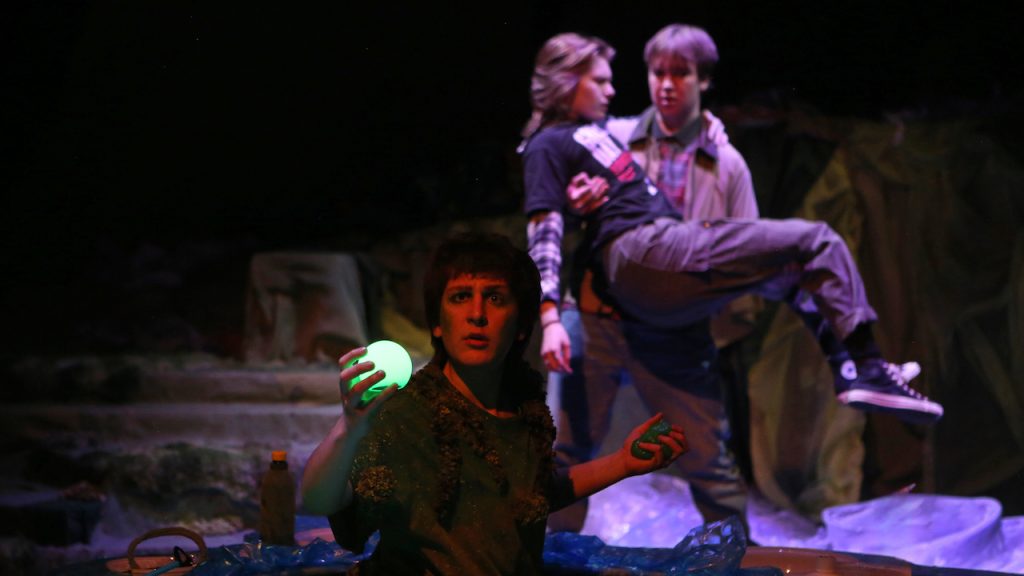
As I made my way into the JKB on opening night, I found myself lingering over a fact I noticed on dramaturg Merritt Baldwin ‘26’s lobby display for a little bit longer than strictly necessary:
“There’s some debate among scientists about whether cyanobacteria are even an algae because they’re prokaryotes and plants are eukaryotes. One could say it defies binaries.”
Admittedly, I don’t know a lot about cyanobacteria, the algae that (literally, given Glassberg’s staging) sits at the center of Bloom Bloom Pow. However, in reading Baldwin’s fun fact, I suddenly felt that I understood why a play pitched to me as a “queer climate-doom comedy” would use an algal bloom to represent both climate disaster and queerness. The play, which follows twenty-something Mag as they return back to their hometown in Ohio, is wildly non-linear, seemingly taking the Aristotelian concepts of unity of time and throwing them across Lake Erie. In doing so, Simon’s writing manages to capture the immense feelings of existential dread and anxiety that are born from returning home, living as a queer person in small town America, and existing in the wake of climate disaster.
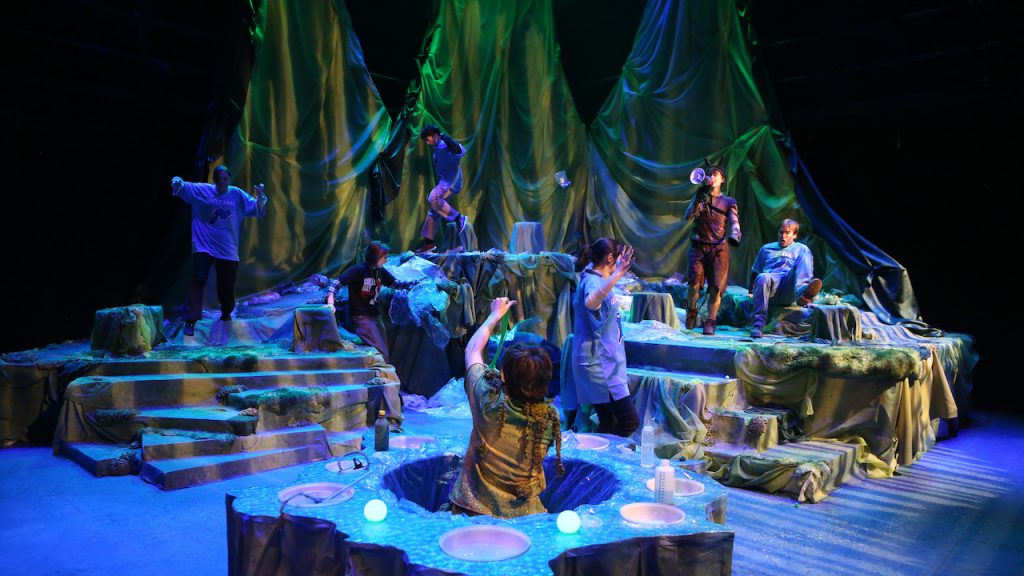
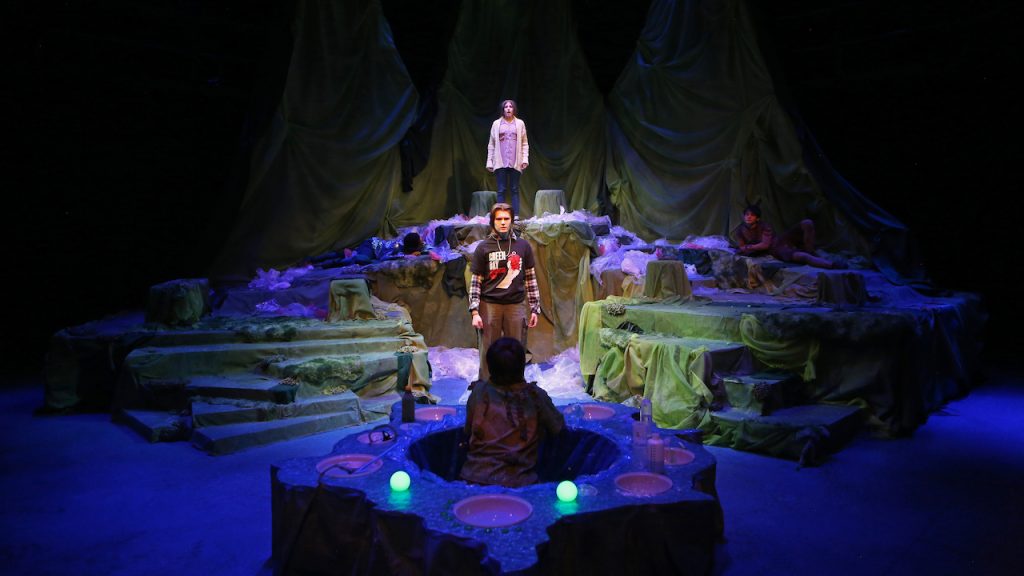
Upon walking into the Black Box, the first thing that I am absolutely struck by is the set, designed by Ella Theoharis ’26. Theoharis’ version of Toledo, Ohio, manages to feel both fantastical and lived in. It is deeply dynamic, with the raised corners of the set allowing various levels for actors to play on. It is Earth-colored, covered in vivid greens and blues. My eyes focus on a small bucket, reminiscent of a kiddie pool, towards the “front” of the set, filled with a motley of small crevices.
The play opened with our lead Mag (Ken Caron-Quinn ‘27) answering a phone call and taking a sharp breath. What followed was a movement piece, performed by the rest of the cast, that sits somewhere on the fine line between a panic attack and photosynthesis. Movement is integral to Bloom Bloom Pow, with much of the play including interludes such as these. As the cast contorted their bodies, a certain connection between humanity and nature became immediately evident, and I found myself questioning just where beings of nature end and humanity begins, a question that seems to haunt the entire play.
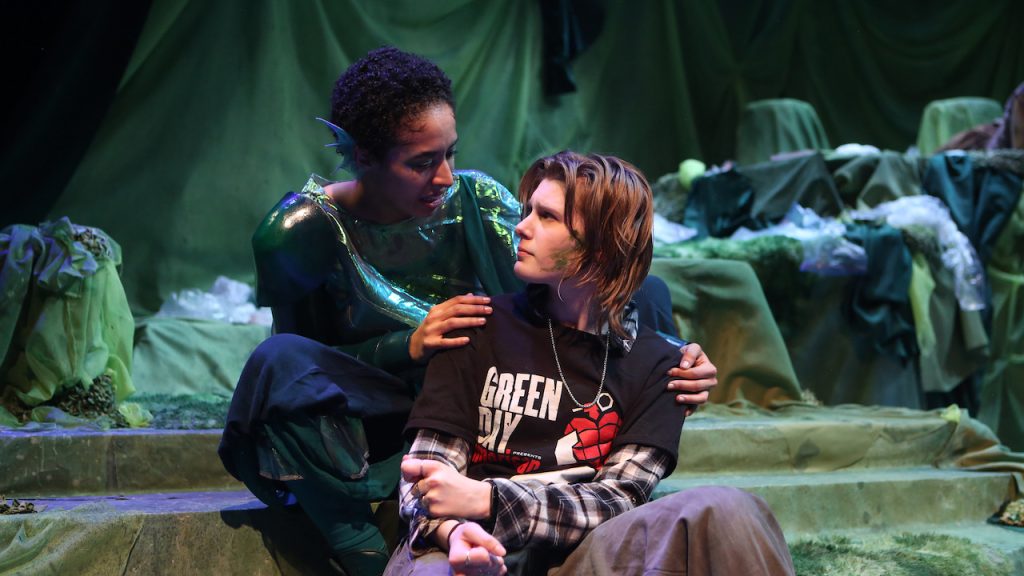
Bloom Bloom Pow was especially unique in its use of video; often, as the action of the show was unfolding, a live feed of specific characters – especially Jordan Azzinaro 26’s Algae – would play. This feed, operated by Camille Klingen ‘28, deeply enriched me in the story of Bloom. For instance, early in the play, Algae writes a message to the audience, begging to know if the onlookers think that they are beautiful. To see this message projected behind them allowed for me to really ruminate on the question at hand – is algae, which seems to be causing active distress for those around it, beautiful? In addition to feeding my analytical brain, though, these projections allowed for a more off-putting energy emitted. As the play devolves further and further into chaos, the projections make the reality of the play feel even less connected – by the play’s end, the projections begin to feel like a form of dissociation.
And, of course, the play would not be what it was without the masterful direction of senior Lu Glassberg. Glassberg’s choices managed to skillfully illuminate a non-linear piece, building a deeply emotional story out of a series of related vignettes. One of Glassberg’s most inspired decisions occurred when Mag and The Creature from the Black Lagoon (Sydney Mann ‘27) danced to “Savior Complex” by Phoebe Bridgers. While the arrangement is strictly instrumental, I find myself mouthing along with the lyrics and thinking of Mag and their relationship with The Creature; “Drift off on the floor/I drag you to the shore” and “Baby, you’re a vampire/you want blood, and I promised/I’m a bad liar with a savior complex” both come to mind. In making decisions like this, Glassberg is able to root a somewhat fantastical play in reality; even as Lake Erie seems to come to life, there is still room for what feels like a deeply real dance to Phoebe Bridgers.
The acting that brought Bloom Bloom Pow to life was also phenomenal; lead actor Ken Caron-Quinn is one of best realist actors I’ve ever seen; their minor anxiety attack at the start of the play, for instance, was handled with such grace and reality that I was tempted to check in and make sure they were okay after. Alyssa Galen ‘27 as Mag’s mother was similar in this regard – her midwestern accent and frantic beseeching to know if Mag is safe or not reads as deeply emotional from an audience perspective. It is through Galen and Caron-Quinn’s deeply grounded performances that the reality of this somewhat non-linear piece feels realistic; even if I’ve never been frantically begging my child not to come home because it is not safe for them, I certainly could relate to Galen’s performance.
Beyond delivering deeply realistic performances of realized people, though, the actors of Bloom Bloom Pow did excellent work in making the non-human world of Bloom Bloom Pow feel realized. This is especially true of Jordan Azzinaro as Algae; Azzinaro plays Algae in such a way that brings out its childlike wonder; they hold up their notes like a toddler showing us their art projects. They eat goldfish and blow bubbles, and we feel a sense of pride when they say their first words, which slowly turns into a list of affirmations – I am beautiful, I am worthy, I am so hungry. Azzinaro’s childlike wonder is well complimented by one of the other more mystical characters of the play, A Dead Horse From the East River, Circa 1832 (Sean Robertson ‘29). The horse is surprisingly animate, seeing as it’s been dead for two centuries. Robertson brings an especially energetic spin on the horse, and I find myself enticed by his monologuing about why I should avoid the East River. And, of course, there is something to be said for the ensemble work of the Great Lakes (pull list), characters who really show off the acting chops of the cast and the comedic chops of Simon’s writing. Perlaza ‘29 as Lake Michigan is especially gifted as he proclaims that he yells at his lake-siblings: “DO NOT COME FOR ME, The people of Chicago LOVE me!”
Bloom Bloom Pow ends as it begins; with a frantic movement piece. Here, we see Algae overtake the stage, as our beloved characters die of various climate crises. We are left with just Azzinaro as Algae, as they send out a final message to the Earth at large: “O, you Earth. O, you divine inheritance.” As the lights fade, I am left to think about what exactly I am inheriting; as I leave the theater, I find my mind wandering to the myriad of climate disasters I have witnessed in my lifetime. While Bloom Bloom Pow may not have been didactic, per Simon’s goals, it certainly forced me to think about how I am going to resist and exist in the wake of the world I am inheriting.
Photos by Sue Kessler
***
Kit Simpson ’27 is the Editor-in-Chief of the Skidmore Theater Living Newsletter