
PLAYWRIGHT’S LAB: “THE LAST ELK” BY SARAH NEEL
posted on May 24th, 2026 by klsimpsonBY DANIELLA SOLOMON ’29
On Monday, April 27th, Studio B of the Janet Kinghorn Bernhard Theater was abuzz with excitement for the final reading of The Last Elk, this semester’s final lab production. The Last Elk was written and directed by Sarah Neel (‘28) and stage managed by Alfie Lafleur (‘29).
As audience members filled up the studio to capacity, actors sat on stage in tableaux, each with their eyes closed. An excellent decision by Neel, this immediately immersed the audience in the world of the play.
The play opened with a detailed description from the stage directions (Maeve Taras ‘28) about how elks came to be on our planet, which piqued my emotional investment in the animal itself. Neel’s poetic writing enticed us into the world of the play, even before the characters had begun speaking. As the stage directions were spoken, actors began to “wake up” and assume their positions, setting their journeys as characters in tandem with that of the elk.
Lottie (Rosemary Pagliano ‘28) is the first to speak, monologuing in a voice memo to her sister Rachel. Lottie rambles as she walks to her college class, telling Rachel how out of place she feels going to school in New England, and leaving behind her family in Montana. As the play takes place in Montana, Lottie speaks from offstage.
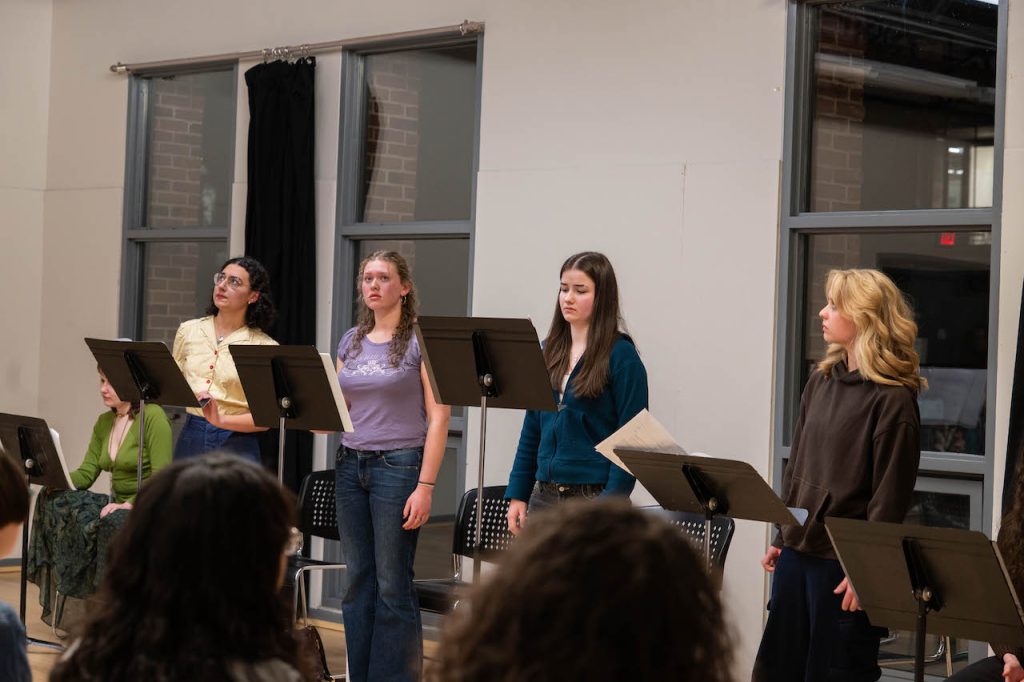
Kat (Annie Pasque ‘29), a stoic college student, is also on the phone, though with her mother, as she walks through the forest where the play is set. As she speaks, we hear Alma (Sophie Komssi ‘29), a quiet but headstrong high schooler, get yelled at by her mother. Soon after, the chatty, valley girl-esque Melodie (Jade Kleinberg ‘28) enters, singing “Good Morning Baltimore” from Hairspray, loudly. This opening scene is underscored by Lottie’s voice memo, a great choice by Neel, as Lottie’s influence on the plot is emphasized from the beginning, even though she is not onstage with the others.
As most of the characters had entered by this point, I began to notice how on-point each costume choice was. Kat was dressed to blend in, Alma was in practical, dark clothing, and Melodie wore bright, loud colors. Despite the work being a staged reading, it was clear that Neel had thoughtfully coordinated the visual elements of the piece.
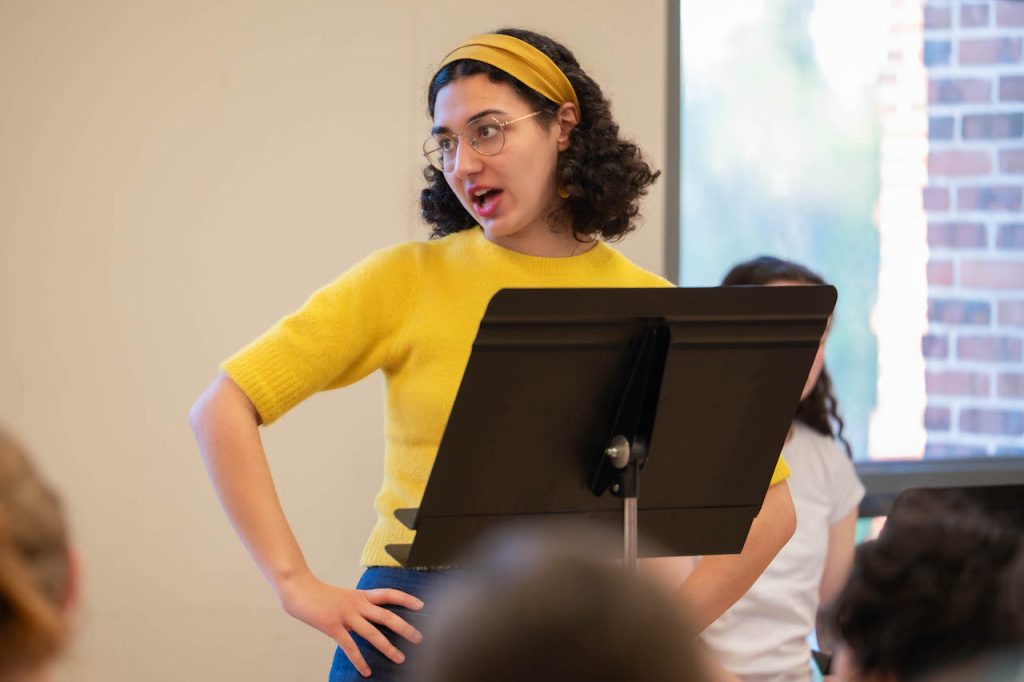
Melodie, announcing that she is in the forest to scout a burial site, goes to the ranger tower for directions, where she finds Rachel (Juliana Mari ‘29). Rachel informs Melodie that she is walking on elk land, but is otherwise dismissive; being an expert on the elks, she is focused on the forest around her. Rachel and Melodie’s clash of personalities here was entertaining, and a moment of great writing from Neel, as Melodie babbles incessantly to the no-nonsense Rachel. Melodie walks on, and we cut to Kat and Alma, who awkwardly stumble upon each other in the forest. We get the sense that these two have met, but before their relationship can unfold, a gunshot startles all the girls. In the frenzy, Melodie and Kat end up right in front of the shot’s victim: a dying elk. In this moment, hilarity ensues as Melodie immediately assumes that Kat killed it, frantically yelling “Don’t shoot me bitch!” Kleinberg’s comedic acting chops shone here, as the audience erupted in laughter at her frantic accusations.
Alma comes back onto the scene, finding the other two girls at the elk’s side. Rachel arrives as well, and she and Kat share an awkward exchange. Again, we get the sense that these characters share a history, though we don’t know what it is yet. This is a major strength of Neel’s writing – tension is slowly unfolding, and exposition feels natural rather than contrived.
Alma goes to shoot the elk, so as to put it out of its misery, but the other girls stop her. Soon, Lottie interludes again in a voice memo. She again attempts to connect with Rachel, asking her to text her back, and telling her she misses her. Mari does an excellent job portraying Rachel’s reactions to these voicemails. It is clear that she is conflicted, but also that she is choosing to ignore the voice messages and power through. Subsequently, Rachel alludes to a “last summer” with Kat, which Kat promptly shuts down. The dynamic between Rachel and Kat becomes clearer; they were close before, and have drifted apart since, although we can’t be sure why yet. Rachel then leaves to find the elk’s poacher. After a little squabble with Melodie, Kat stalks off too, leaving just Melodie and Alma onstage. Alma goes off to find materials to bury the elk with, and much to her surprise, Melodie invites her to come back afterwards. It’s clear that Alma isn’t used to people paying attention to her, which makes for an awkward but sweet moment when Alma accepts. As Alma leaves, Melodie breaks into a rendition of “This Land is Your Land,” directed at the elk.
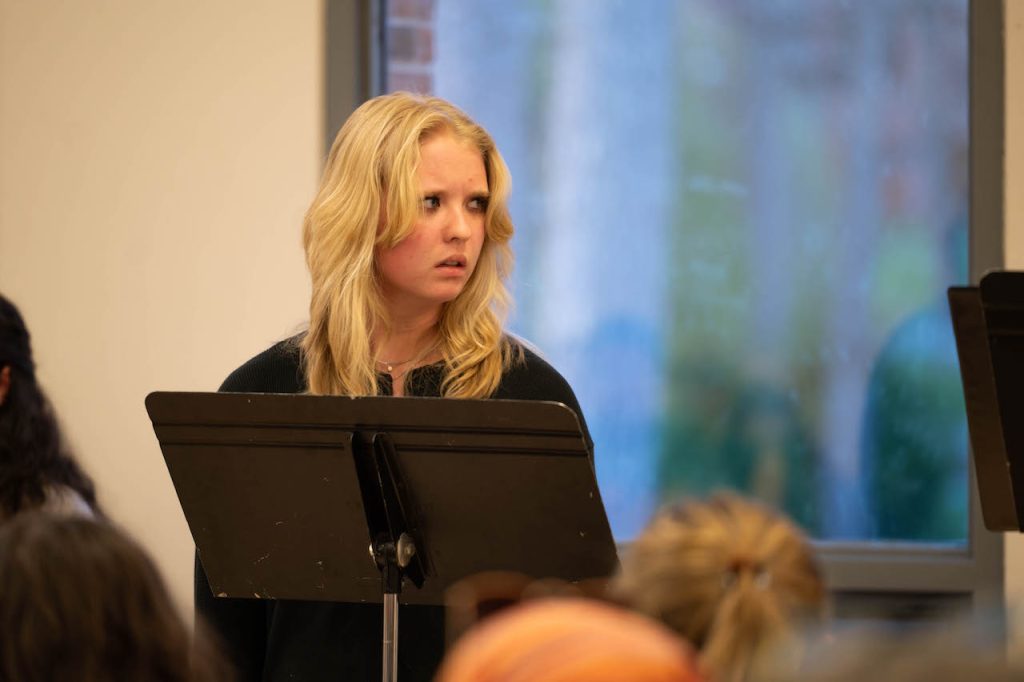
Rachel is now walking through the forest, hunting ferociously for the elk poacher. Lottie’s voice is heard on another voice message, again telling Rachel she misses her, and asking her to call. Here, Neel’s choice to use voice messages instead of phone calls is especially poignant, as it becomes increasingly clear that Lottie’s attempts to reach out are one-sided and never reciprocated, but she wants Rachel to hear her voice anyway. Rachel again ignores the voice message, and seconds later, collides with Kat. Kat takes the moment to apologize to Rachel, and it soon becomes clear that the two of them were in a relationship the summer before. Rachel alludes to someone else in Kat’s life, and Kat diverts and tries to leave, but finds that she’s lost and has to stick with Rachel. Lottie comes in on a voice memo, this time beginning to be angry at Rachel for ignoring her. But Rachel ignores her anyway, and suddenly the ground starts shaking. This is a great moment of writing by Neel, as the physical world of the play begins to represent the psychological turmoil of the characters.
Alma and Melodie are back together again, this time trying to bury the elk. These characters feel like an unlikely pairing, but the moment really highlights Melodie and Alma as foils for one another. Both characters are going through something, but Melodie externalizes her pain, whereas Alma internalizes it. These contrasts make for a really sweet exchange between the two characters, and Neel’s choice to pair the two girls together really works. Melodie reveals that her aunt is dying and that she’s been sent there to take care of her. Melodie’s genuineness prompts Alma to talk, and Alma reveals her frustrations with her family and school life. The moment was beautifully acted by Kleinberg and Komssi, as they represented the complexities of two very guarded girls finally revealing their past to someone.
Another voice memo from Lottie comes in, again ignored by Rachel. This is followed by another shake in the ground, as the scene turns from Melodie and Alma to Rachel and Kat. The latter pair keep walking, and find themselves standing in front of a dying baby elk. As Rachel tries to help it, an argument flares up between the two girls. Kat insinuates that Rachel’s care for the elks is a misplaced need for power. She criticizes Rachel for stubbornness, for never changing. For the first time, Lottie and Kat speak in tandem: “But you never change.” Here, Neel’s writing shone, as they deftly combined the timelines of past and present.
Soon, the shakes in the earth become louder and more frequent – it is clear a natural disaster is on its way. The girls all panic. A voice memo plays, but this time, Rachel can’t ignore it. Kat and Lottie speak in tandem again, Kat expressing her fears of change and revealing her pregnancy, and Lottie attempting to help Rachel. In the chaos, the mother elk is shot and killed. Rachel explodes in a fit of panic, trying to find the other girls and the baby elk. Mari’s range as an actor was evident, as she showed Rachel’s devolving from composure to panic to anger in the space of less than a minute.
Finally, the girls are all together as they watch the baby elk die. They sit in silence for a moment before Melodie speaks, expressing her wish for a new world, without the problems of their old one. Rachel speaks next, revealing that Lottie was her twin, and that she is dead. As the tragedy of this begins to register, the final voice memo from Lottie is heard. Lottie says that she’s done trying to reach out to Rachel, but that she loves her and will see her soon. Lottie then appears next to Rachel, the first time she is onstage in the show, and they embrace, before Lottie disappears for good. This ending beautifully wove together the past and present worlds of the play, leaving the audience with a heartbreaking yet satisfying conclusion.
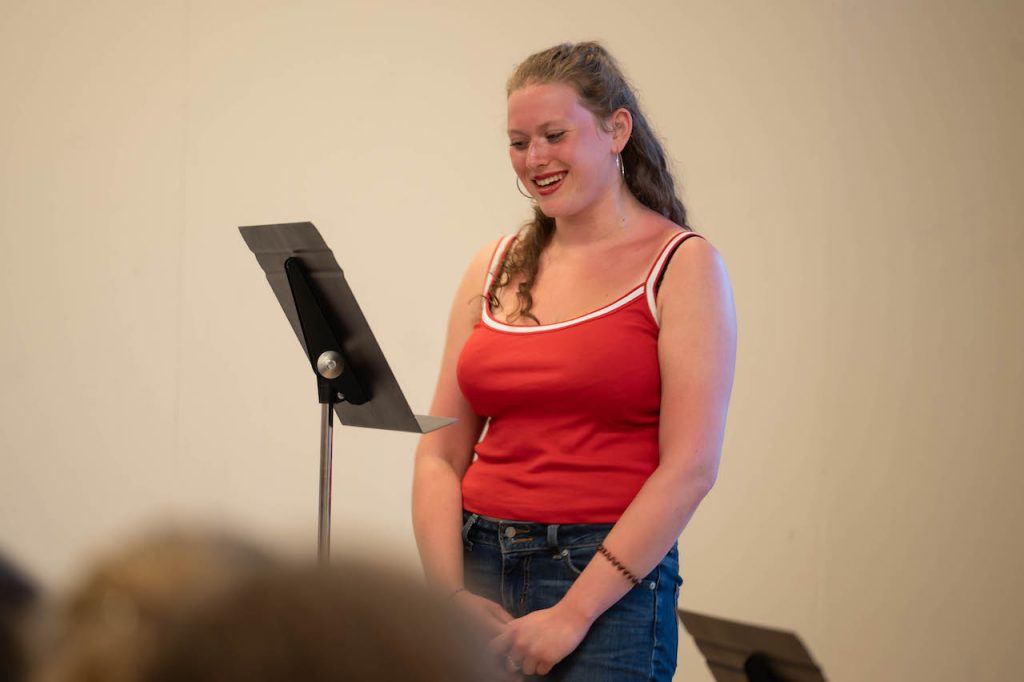
The Last Elk is a stunning representation of what happens when we cut ourselves off from others and avoid our past, and how we can recover from it. With an ensemble of five excellent actors, there was not a weak link in the bunch, and each contributed to the story in a unique way. Neel managed to create five equally fleshed out characters, while expertly maintaining the story’s pace and suspense, a balancing act that demonstrated their immense prowess as a playwright. The Last Elk absolutely left an impact on the audience, and I’m very excited to see where Neel takes the play in the future.
Photos by Logan Waugh ’26 and Camille Klingen ’28
***
Daniella Solomon ’29 is a staff writer for the Skidmore Theater Living Newsletter