
BY EM WILLIAMS ’28
The Spring 2026 Mainstage Production of The Trees, written by Agnes Borinsky and directed under the brilliant eye of Sara Lyons, was unlike anything else I had seen performed at Skidmore. Running at the same time as the disorienting weather changes in Saratoga Springs from April 17th – 25th, the production flipped the perspective of the audience from viewer to player, seating us on the stage, while the cast frolicked in, or remained rooted to, the undisclosed Connecticut Park setting before us.
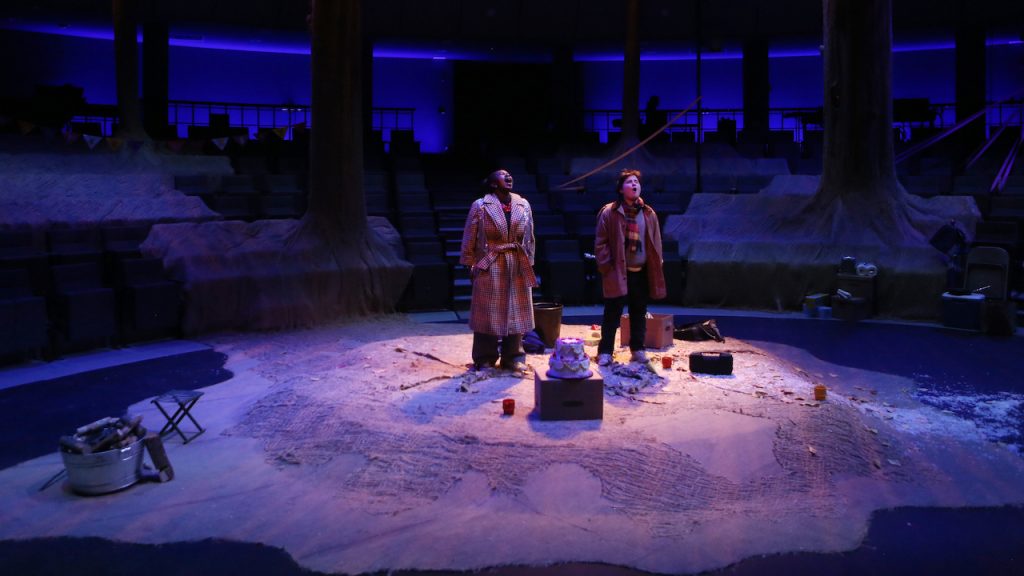
The set used the JKB’s seating to convey the uphill walk that led to the lead’s beloved home, while also offering foreshadowing of the show’s plot. We, the viewers, will continue to operate as a play within a play—acting out our parts in life. While our primary characters will remain there in the “audience”—among the impressively designed trees; beneath the immense soundscape of birds chirping and wind blowing; surrounded by the fluttering seasonal changes indicated through flower petals, leaves, and snow; and planted in the netted roots that began to grow around them.
In relation to the narrative itself, The Trees is constructed around a center piece, being the two aforementioned actors who watch the world move without them, and delivers a symbolic commentary that relates to a variety of social issues and conflicts. Deforestation, colonization, capitalism, and forced family interaction were only just some of the prominent connections I found within the show’s roots, but among these concepts, and many others, one constant theme remained emotionally and physically present among them all: change.
Upon the show’s opening, the principal leads, siblings David (Theo Leff ‘28) and Sheila (Beti Essa ‘28) had returned home from celebrating the life and mourning the loss of their father when their exhaustion and intoxication took hold of them, falling asleep in the sloped meadow by David’s house. However, their lives instantly became very different when they awoke and discovered that they had been rooted to the ground. The sequence perceiving this “growth” that tied David and Sheila down was performed by the supporting cast. This not only introduced the community that was about to join the siblings’ lives but also alluded to the idea that they are metaphorical roots who help make this immediate change less daunting.
Leff and Essa did a fantastic job of illustrating the deep and complex relationship that David and Sheila had as siblings. Essa as Sheila was optimistic, strong-spoken, and ambitious, not allowing this new challenge to bring down her spirits. Yet, her inner-turmoil was ever present through Essa’s acting choices: talking about her strained relationship with their deceased father and her having cancer. David is quite the opposite. Leff’s body language throughout the performance actively portrayed David’s pessimism around their situation and wariness to confront others at the risk of losing others or opportunities that he believes that he and Sheila will be helpless without. For Sheila, it was finding her community and for David, it was finding his purpose; It was the time that they were forced to spend together that allowed them to see the raw emotions and feelings they had attempted to hide from the world for years.
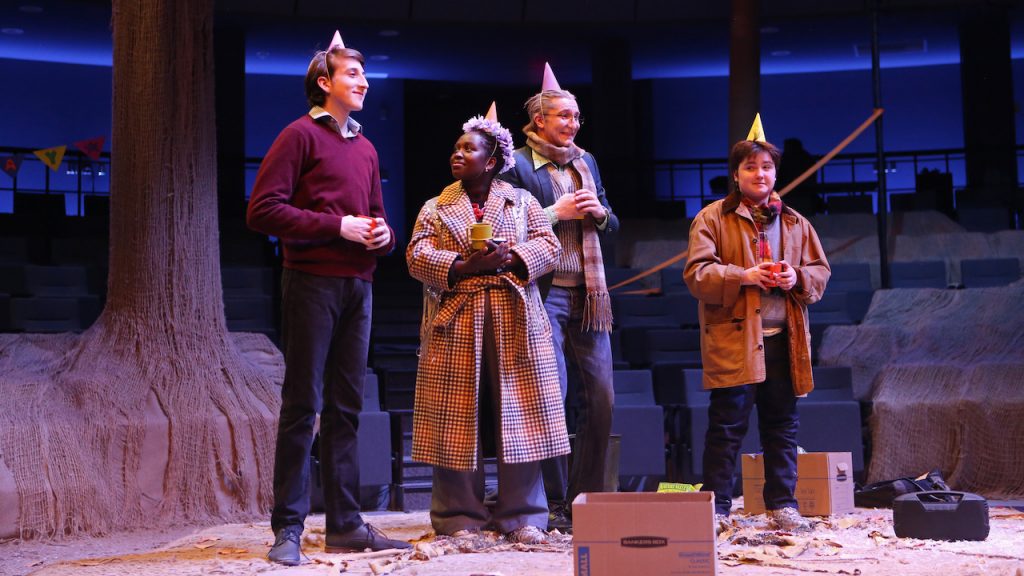
Though “the trees” themselves may be the most changed by their new life, the supporting cast equally presented how David and Sheila’s circumstance altered their lives and perspectives. Charlotte (Lila Sandler ‘27) portrayed how one’s difficult moments can weigh down the people around you. In the beginning, Charlotte was ever eager to help, but with her own personal issues and her protruding stress, she takes a step back to focus on herself. Sandler especially handled Charlotte’s unspoken thoughts really well. It was clear that Charlotte didn’t want to hurt Sheila and David by expecting anything in return, but she also could not handle the pressure to tend to them as her life outside moved on. When she returned at the end of the show, Charlotte demonstrated how life also changed for her through her divorce and how much she missed Sheila. She may have had to leave, but Charlotte came back stronger and willing to try again.
In contrast to Sheila’s closest confidant, Jared (Harry Fitzgerald ‘29), as David’s ex-boyfriend, jumped to conclusions from the beginning and drew a professional line between him and David. This disassociation led to the key conflict presented later into the story—the mall. Jared’s dehumanization of David and Sheila as “trees” alluded subtly to how indigenous groups have been displaced from their homes and rendered less than their colonizers. Fitzgerald, however, characterization of Jared softened the blow in a way that reminded me how colonization is whitewashed to condone the actions of the past. What I particularly appreciated, too, was how Jared was never forgiven for his choices, but improved himself and took time to understand his inhumane treatment of David and Sheila, accepting change for the betterment of those around him.
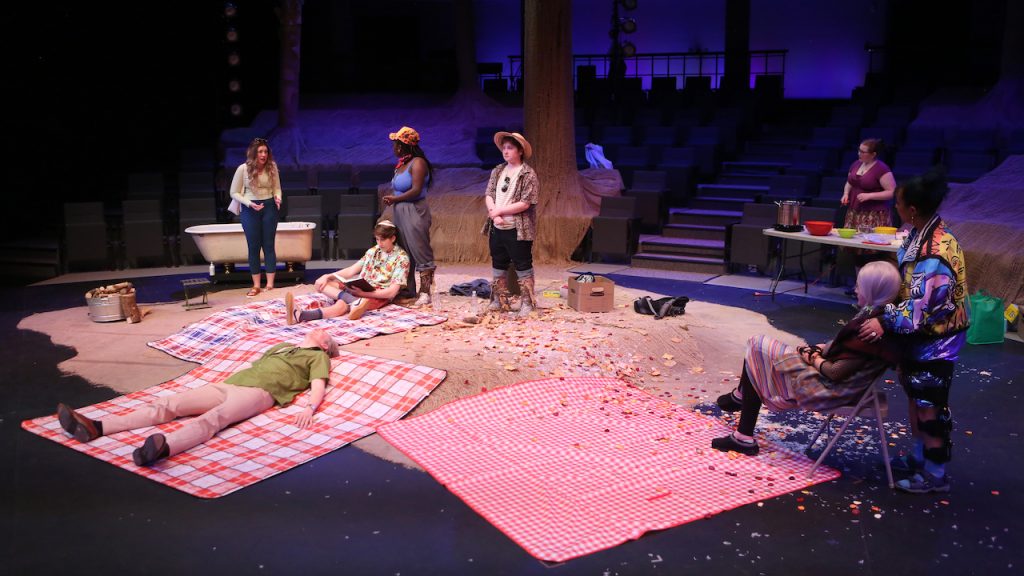
Baba (Grace Whitney ‘29), meanwhile, had lived many lives—as said in the show—and displayed an outstanding amount of humility. For most of it, Whitney was a caring and comedic presence—speaking in Polish, pinching Leff’s cheek, and getting sprayed by a hose while trying to make a harmless campfire; but, when she stepped out of Baba’s native language, Polish, a new tone rested in the theater. Her telling of David’s burning house and the anecdote about her village, both demonstrated how nothing lasts forever. My favorite line in the show came from Baba when she said, “if you don’t plant yourself, you’ll fall.” To be planted is to remain resilient and forewelcoming of change with the understanding that it will never make oneself falter. Whitney’s harrowing tone and direct eye contact spoke deeper into my soul than anything else. It was a strong reminder that there is no timeline to life and so many things are out of our control as people, but we can also never lose sight of who we are.
The colorful duo composed of Tavish (Coro Holt ‘29) and Julian (Theo Perkins ‘28) shared a role in presenting two tracks in early adulthood. Amidst trying to find himself through his college education, Julian struggled to show up when everyone else did because he could not ride with his own wave. His heart was set on one thing, but found himself in a different place down the line. Tavish, in contrast, was proud, logical, and confident through their identity and how they helped David and Sheila navigate tough decisions. Even when their leg was injured in the fire, Tavish shifted but was able to move with the wave. Holt’s darker blue and purple clothing juxtaposed with Perkins’ lighter pink and pastel also visually alluded to their contrasting responses to change. When Julian finally found his purpose, he demonstrated that everything will work out eventually, whether it is the Tavish way or the Julian way.
On the other end of the age spectrum, Norman (George Fortin ‘28) takes in the world at his own place; however, Fortin’s tone and cadence gave the audience time to catch on to the deeper and wiser edge of Norman’s words. Cheery, and at times raunchy, he lit up the room in the rest of the cast’s darkest moments, while also shedding light on his own struggles. Norman primarily battled with the concept of making up for lost time and wanting to find a purpose in helping David and Sheila. Underneath the positivity, Norman laid out the fact that he had yet to find his place, and with the help of the rest of the cast, he finally found it.
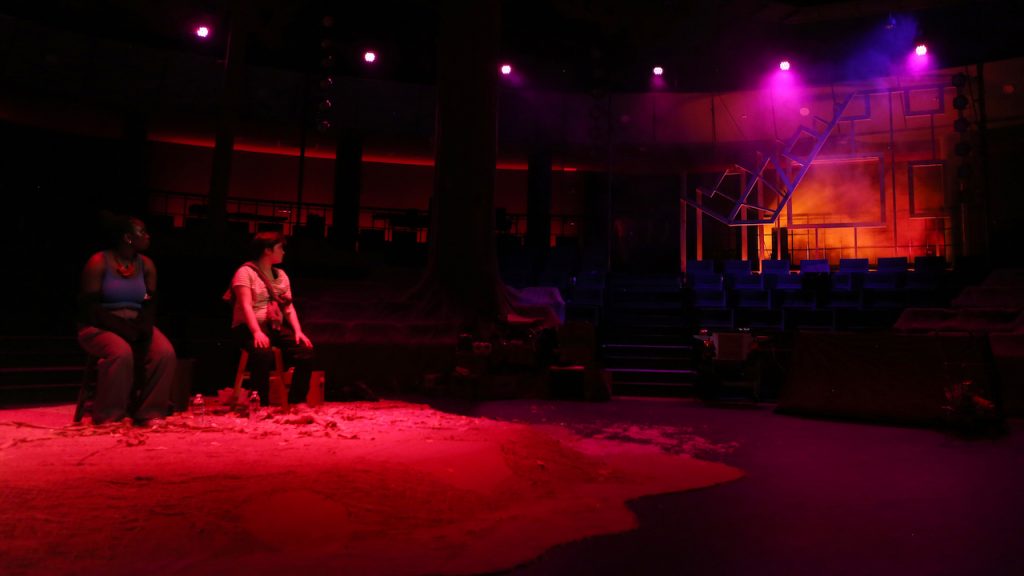
Saul (Jake Siegel ‘29) fell under a similar category as Tavish. Confident in his Jewish faith as a Rabbi and willing to uproot his life in Ohio to move to Connecticut, Saul provided the most open perspective to change. No fear laid in his choices to move, stating that David and Sheila are a miracle; an example of what humans will eventually do—rest. Siegel’s positivity and tranquility sold Saul’s honest intentions, and his actions were inferred to have opened Sheila up to be more encouraging of her new life.
Sheryl (Anna Staltari ‘28), I found, was able to provide something alike to this new perspective that Saul bestowed to Sheila. Divorced from the initial conflicts and tribulations that David and Sheila went through, Sheryl could not conceive what the rest of the cast had experienced, but played a strong role in learning to move on. Staltari’s nervous energy as Sheryl, while sharing her reflection on the loss of her own father, exposed how the community had formed into a welcoming and safe place for any newcomer. She recollected on how her father was not necessarily a good person, but it was hard to perceive that he was gone, highlighting again how change brings forth complicated emotions that take time to process. It was this brave moment that left Sheila and David to reflect on the anniversary of their own father’s death—allowing them to realize that they had finally planted themselves and persisted past the changes that had occurred.
Then, there was the Vendor, or Terry, (Nora Steckline ‘29) who was probably the closest representation of an antagonist. Throughout the production, she was a dreamer, wanting to make a sale, to become something more, and to achieve something greater. Her gig started small, but the more time she spent around Sheila and David, her ambitions began to grow. Steckline did an incredible job depicting this shift as Terry became infatuated with the idea of the mall, while also demonstrating that Terry had humility when she stepped up to take Baba to the hospital. However, it was when Ezra (Jane Langan ‘29), Sheila and Saul’s son, blatantly stood up to Terry about the mall, the rose-tinted glasses shattered, replaced with the raw truth, and then confirmed by David that he wanted to end the construction after about five years of planning.
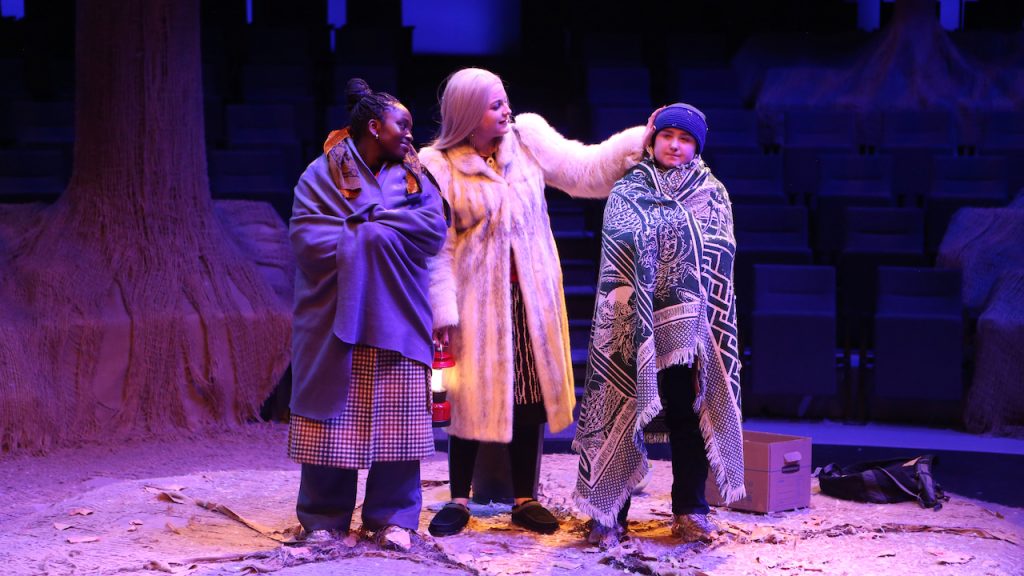
Members of society who choose to follow their capitalist regime try to make use of the system to be successful; however, they may inevitably fail to beat the system because it is corrupt and flawed. When Terry blew up in response to David, the idea to take away is not that David was wrong to stand up for himself but rather rests in what Terry relayed: that this was “the project of my life.” Terry’s conflict rested with the American Dream. Everyone is meant to make it big; yet they rarely earn their deserts. Capitalism affects everyone, and constant changes in society and the expectations placed on the work force to keep moving to support themselves is enforced through this production.
At the end of the performance, David felt guilty that he could never give anything in return to the community for what they did to take care of him, but Sheila quickly shut him down. It was the trees, she said, that brought others to life. They brought others love and allowed them to breathe. And, it was completely true. It was David and Sheila who had brought this wonderful community of people together and allowed them to love themselves again.
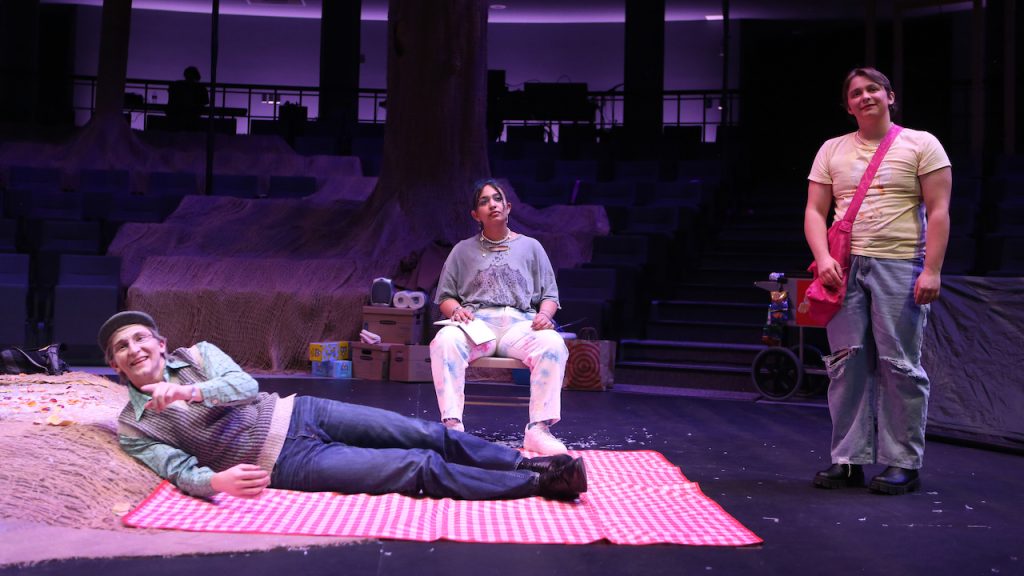
The Trees proved to me that anyone, no matter their background, could find a common ground, a bonding interest, and a drive that propelled them to remain in the park. Walking out of the Mainstage to the lobby where people filled their bowls with soup in front of the box office filled me with a sense of warmth and comfort. By presenting us with soup—a sharable, communal meal—the cast invited us into their community; a safe space where people can process time in slow motion; where they can feel like time has stopped. If only just for a little while.
Photos by Sue Kessler
***
Em Williams ’28 is a staff writer for the Skidmore Theater Living Newsletter