
BY KIT SIMPSON ’27
Car Games, By DC Cathro and directed by Sarah Neel ‘28, played in Studio A, from October 19th-20th.
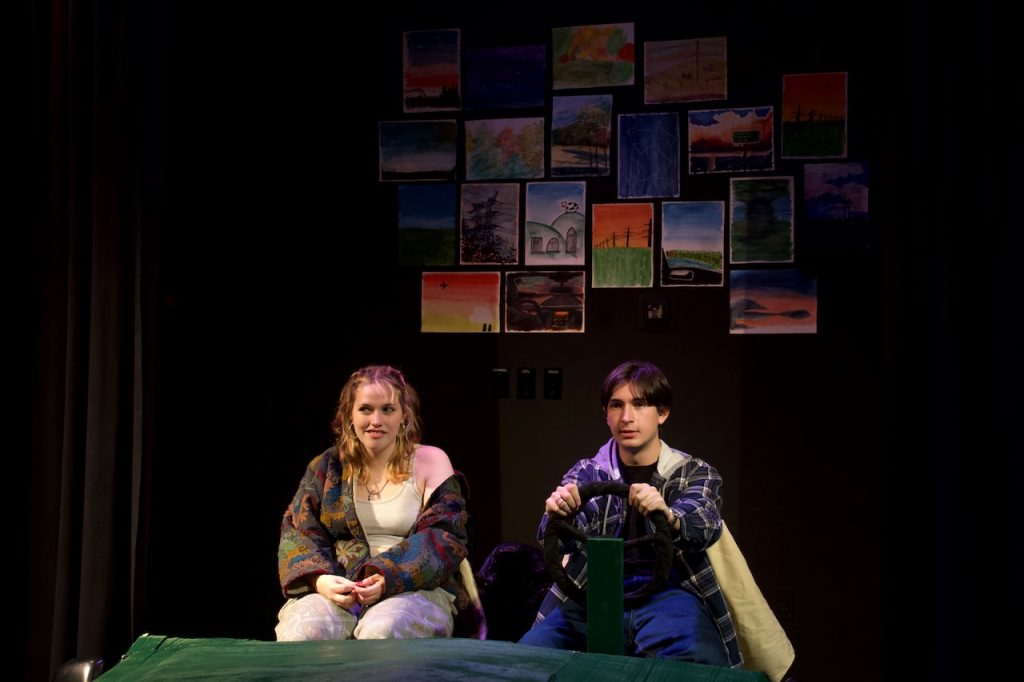
When I walk into Studio A, the first thing that I am greeted with is the large green hood of a car, and dotted white lines to signify a road. The dotted white lines are already a strong design choice from set designer Theo Perkins ‘28 and Neel. For those unaware of the rules of the road, separate two lanes going the same way, and are often found on highways. In a way, we can understand this style of line as in some way representing Anne (Camille Klingen ‘28) and Roger (Ben Wakefield ‘30), two characters who are (literally) going the same way but are divided.
Also onstage is Roger who is sitting, contemplative, and engaging in the art of staring out into nothingness. “Vienna” by Billy Joel is playing. As the show begins, Anne awkwardly leaves her home, only to be met with playful resistance from Roger, who is irate at Anne’s request to open the door. Wakefield does good work in playing Roger, the type of man to mutter under his breath that a woman is a “fuckingsonofabitch” (stylized as such by Cathro), in such a way that the audience still in some way enjoys his company.
Their car ride is warm, but awkward. The two seem connected–and we later learn very much later that they were, for a period, sexual partners, and are traveling to get Anne an abortion. The two bicker, often over music–Roger likes Billy Joel, Anne likes a solid mix of top 40 hits (including an incredibly well selected “Manchild” by Sabrina Carpenter) and classic rock. Wakefield and Klingen have stellar chemistry, effortlessly balancing the bickering between the two and the intimacy that is born from an extended stay in one car: perhaps the most striking moment in the play is when Roger reveals that he has an ex girlfriend who passed away, who he seems to carry a complicated relationship with.
Eventually Anne, bored out of her brain on this incredibly long road trip, suggests playing car games to pass the time; her three main suggestions are punch-buggy, (a road trip classic!), “Cows” (wherein one counts cows on the side of the road) A-to-Z, a game which requires both players to spot things along the side of the road, from A-Z. These games also do work to highlight the confined space of a car. If you’re stuck in the car with a stranger for an extended period of time, sometimes the most interesting thing you can do is count cows.
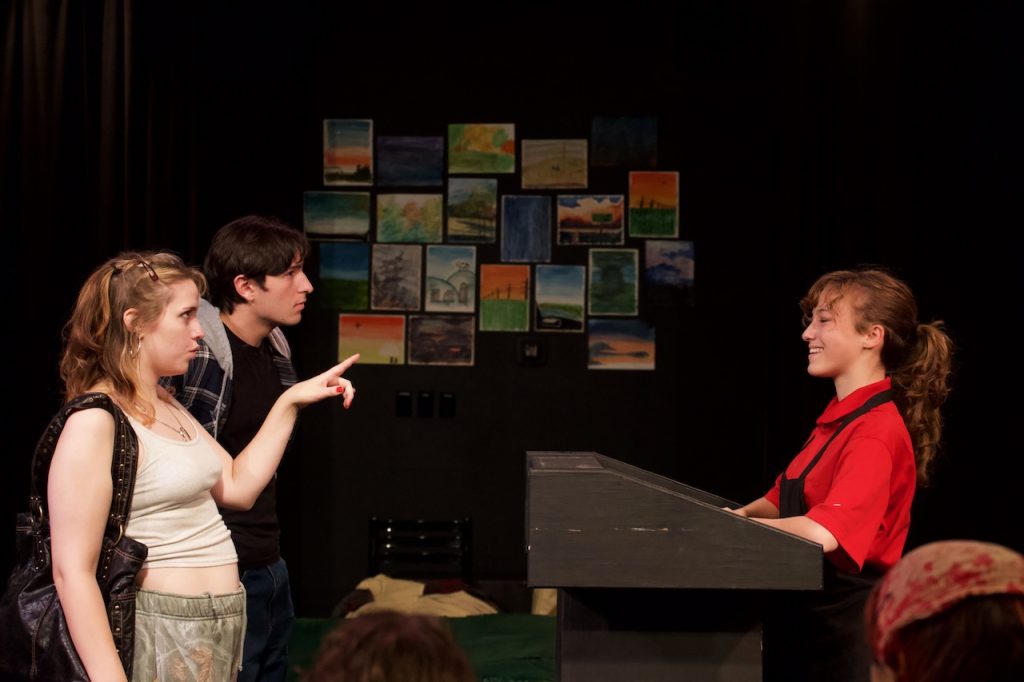
The car games also set up a certain power dynamic in the car: loser buys the winner’s meal, and the winner gets to both pick the locale and the music for the rest of their trek. Anne wins, and so the two stop for food, which includes a very amusing interaction with a cashier played by Viola Edwards ’30. Again, we see a place of fundamental contention between Anne and Roger: Roger heavily critiques Anne’s choice of fast food joint (McDonald’s), as well as her choice in food at said fast food joint (greasy food). This moment is one that is well-acted, and also well-directed: it is a rare moment where we see both characters outside of the car, and Neel did good work in showing the immediate distance between the two outside of the confines of the car.
The play’s most powerful moments happen when the characters are reminded of their circumstances; at one point, Roger half-playfully, half-snarkily remarks that something is Anne’s fault, and Anne breaks down a little. Klingen’s skill as an actress really come to fruition at this moment. As she makes her way through the line, it feels from an audience perspective that she is, for the first time, reckoning with her circumstance: when this road trip is over, she will have had an abortion, a fact which will, at the very least, emotionally change her life.

The play is incredibly focused on the interiority of Roger; no moment makes this more clear than when the two finally arrive at their destination, and Roger starts to doubt the decision that’s being made. As a protestor (Viola Edwards ‘30) stands outside, Roger starts to question if they’re making the right choice. Still, Anne goes through with the procedure, as Roger cries in the car, alone. (At Anne’s insistence–she wants to get her abortion alone). When the procedure is over, it is Roger who is comforted, not the other way around as one may expect. Wakefield did excellent work in making Roger come off as likably selfish in this moment; being charismatic as a man crying over a woman he is not even dating’s abortion is a tall order, and Wakefield manages.
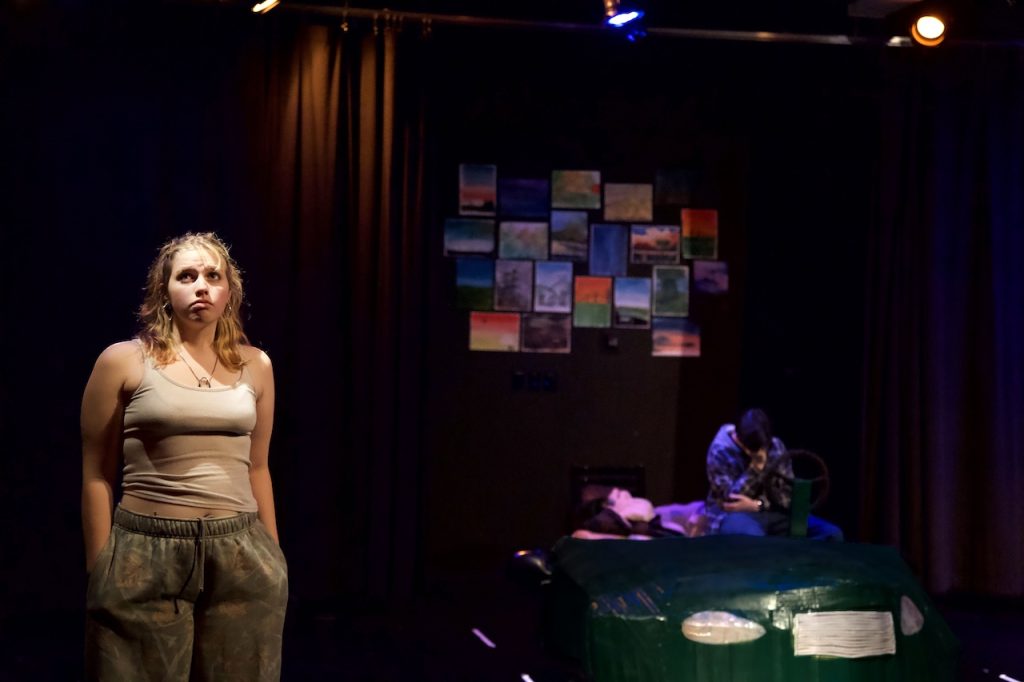
One of the most overwrought clichés of the road trip narrative is the idea that it is not the destination that matters, but the journey. Cathro’s Car Games, alongside Neel’s stellar direction, seems to prove this fact: Anne’s abortion–and Roger’s private reaction to that abortion–are solitary endeavors, but neither of these moments seem to be nearly as important as the road trip taken to experience these solitary ends.
As my friends and I filed out of Studio A, I found my mind meandering over the idea of a car as a liminal space; nobody’s destination is ever the inside of a car, and yet, it seems a space for growth. Over the course of the play, for instance, we watch Roger and Anne, two characters at pivotal moments in their lives, grow both as people and as a pair, which made Car Games an engaging and emotionally gripping watch.
Photos by Thea Fischmann ’30
***
Kit Simpson ’27 is the Editor-in-Chief of the Skidmore Theater Living Newsletter