
BY MOXIE MILLS ’27
I had the privilege of watching the Janet Kinghorn Bernhard Theater’s production of Horse Girls, which ran from October 5th-October 6th in Studio A, and now I am making it everyone’s problem. Director Maggie Hogan ’27’s wise words, “boys come, boys go, but horses are forever” now rest on the whiteboard that hangs on the fridge in my apartment. Horse Girls is a freeing reminiscence upon the disaster that is female adolescence.
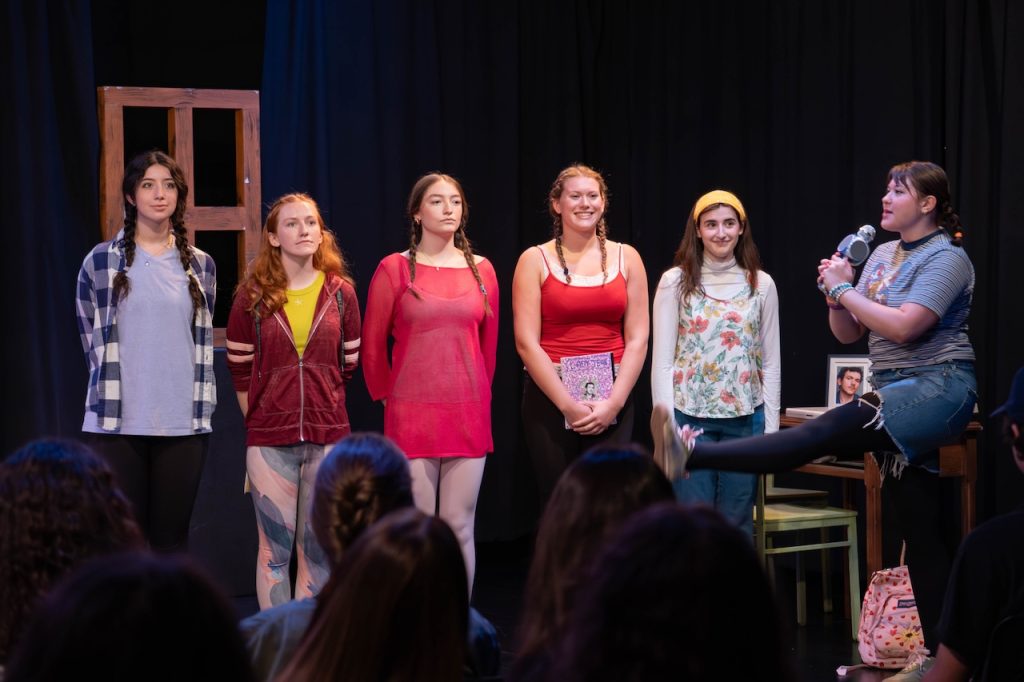
The show takes place over the course of one singular meeting of the Lady Jean’s Horse Girls Club. The club consists of seven middle school aged girls who share a particular affinity for horses. They meet each week at Trish’s house–a fabulous mansion with an intercom system and a view of the stables–for passive aggression, paying dues, and journal sharing time. But the meeting at hand was no normal meeting; there was a special guest, a late arrival, an alarming revelation, a devastating lack of virgin strawberry daiquiris, and –gasp!–cold blooded murder.
At the start of the play, Ashleigh (Nora Steckline ’29) was already on a warpath. As queen bee and president of the club, Trish thinks quite a lot of herself, and this comes across clearly even in the
first few minutes of the play, as she demanded that someone braid her hair. Margaret (Treya Glass ‘29) was very happy to oblige. Tiffany (Sky Estrada ’27) and Robin (Hazel Curry ’30) observed uncomfortably. Camille (Jade Kleinberg ‘27) arrived with her cousin Trish (Jemima Constantino ‘30) soon after. Poor Trish. That girl had no idea what she was getting herself into. Camille does a very awkward round of intros for her cousin, which is a deft way of helping the audience learn names, too. Kleinberg’s awkward delivery as she introduces Tiffany in particular is unfortunately relatable to many; it’s the classic sucking up that one has to do when in the presence of a friend’s older sibling, as Tiffany is Robin’s older sister.
The group settled in a circle on the floor, where they discussed the money they are raising and upcoming events on the equestrian calendar. Tiffany–sweet, gentle, and clearly tired of Ashleigh–admitted to her acceptance at a rigorous summer horse camp, much to Ashleigh’s chagrin. Ashleigh declared that Tiffany would not be going–she is the only one who ever gets to go to these elite events, which is how she won the massive trophy on display in her room.
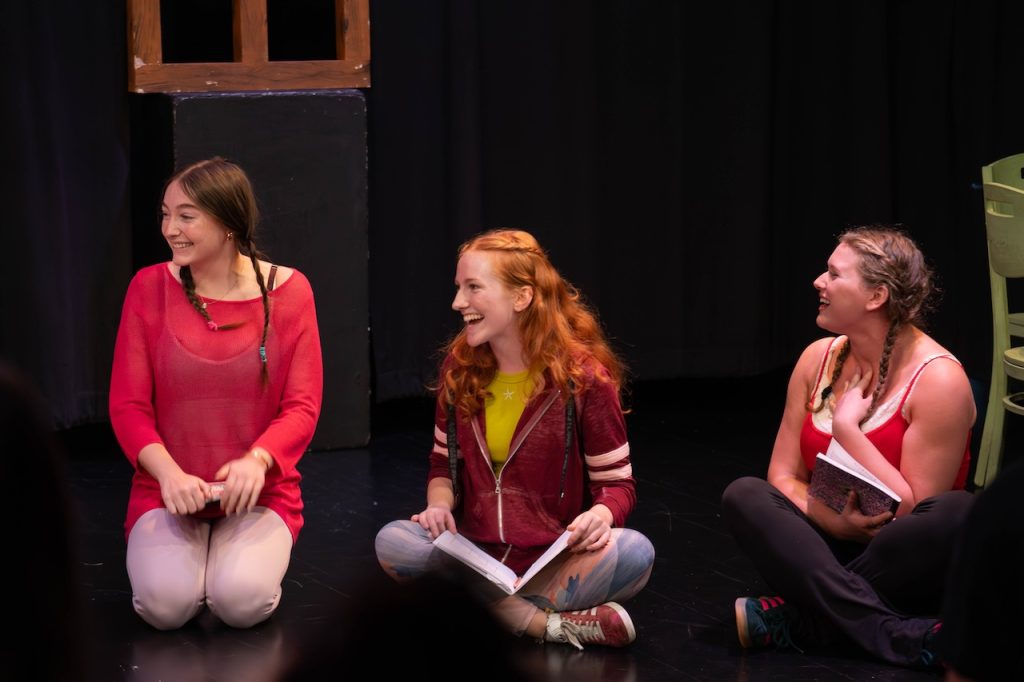
Whenever the conversation veered away from Ashleigh, she managed to center herself again by mentioning the magic words: Jonah Stockamore. Twenty-years-old and the most gorgeous equestrian who has ever lived…and allegedly dating twelve-year-old Ashleigh. Even Trish is wowed by this information, because Camille speaks of Jonah frequently and has framed him as a legitimate celebrity. Ashleigh has to remind everyone that Jonah kissed her in the stables (a particularly romantic location for one’s first kiss) and that they’ve been an item ever since.
Every so often, someone mentions Brandi’s tardiness, which is met with compassion from Robin and Tiffany, discomfort from Camille, ambivalence from Trish, and outright frustration from Ashleigh. Brandi, while not present at the start of the play, felt like a very prevalent, important character. My friends and I agreed that when Brandi did finally arrive, it was like seeing a celebrity in person.
Each girl had a turn to read from her horse journal. When moved by the spirit of the horses, they
would rap their knuckles on the floor to create a ‘clip clopping’ sound to respond to each other’s
sharing. Details like this, I think, are what put the play over the top. This group’s horse adoration
is aggressive and nearly uncomfortable to witness, and therein lies much of the humor. Estrada’s
quietly delighted suggestion to make the clip clopping sound will be forever burned into my
memory, as it was so deeply unsettling to witness. As each girl reads her poetry, clip clops
reverberate through Black Box, creating a bizarre cacophony of sounds that can only come from
the strangest of horse girls.
I found the play enchanting from the start, but it was Brandi’s late arrival that was truly engaging. Ashleigh attempted to berate Brandi (Rosemary Pagliano ‘29), but Brandi refused to be deterred; she has a message to share, and it is a doozy. Brandi claims to have had an almost Cassandra-esque premonition of strife at Lady Jean stables, and ran all the way to Town Hall to investigate. This was where she heard the devastating news that the stables are to be sold and the horses are to be slaughtered and eaten in restaurants. As a twenty-two-year old, I was immediately skeptical of this proclamation, but watching the horse girls onstage lapse into psychosis at the news, I thought back to the things I probably catastrophized over at twelve, and their reactions seemed fairly reasonable. Isn’t it part of the middle school experience to love something that much? I was moved; the lighting went dark and each girl screamed and cried and threw things and held each other. While my instinct would be to fact check, I found their twelve-year-old instincts to throw explosive tantrums to be very captivating.
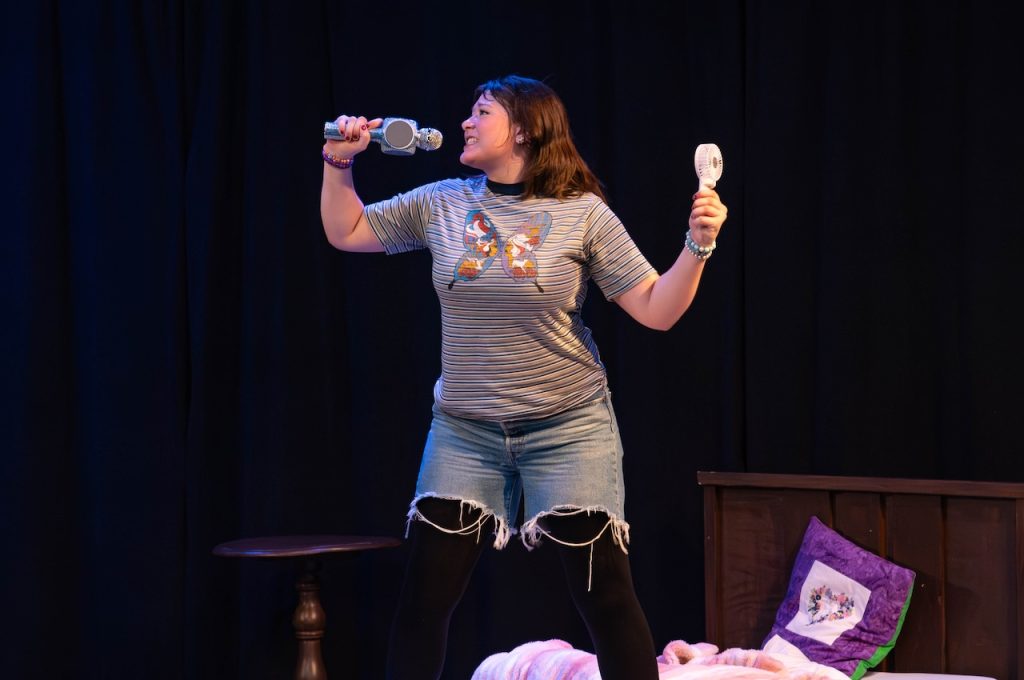
The girls did eventually pull themselves together and try to relax…by singing an original musical
number about Ann Romney. Never in a million years would I have anticipated such a twist. The
choreo was disastrous. Not a single note was hit. It was exactly what one would hope a musical
number about Ann Romney to be. Simply magical.
This gorgeous song inspired the girls to take action! Robin did some digging and uncovered a phone number for the White House online. Yes, the girls believed that Ann Romney is the FLOTUS. What a beautiful thing it must be to be so sorely misinformed. The call to the White House, unfortunately, was a flop; Ashleigh was furious when the operator offered to connect the girls to the gift shop. It warrants mentioning, of course, that the audience is in stitches over all of this, but the cast does not crack a smile. To the Horse Girls, the world is ending.
The group decided to take a brief recess. While all of the other girls headed downstairs, Ashleigh
grabbed Tiffany and kept her in the bedroom for a secretive conversation. She proposed that they
hop on the horses and gallop away, but Tiffany had reservations. But Ashleigh refused to take no for an answer, so Tiffany tentatively agreed.
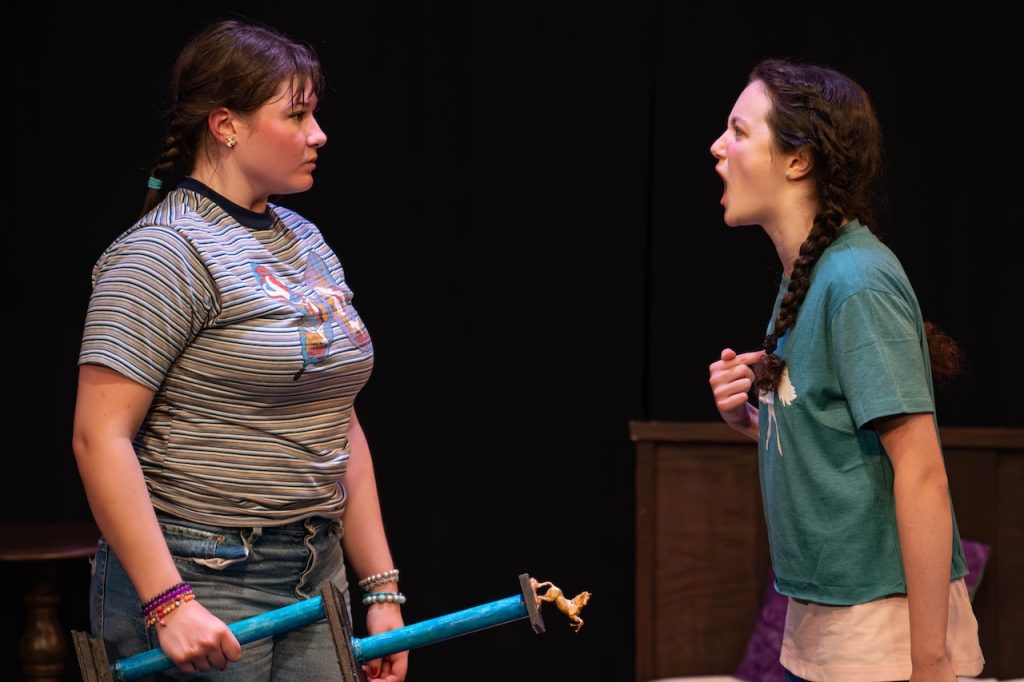
Ashleigh, in a frenzy, packed a suitcase (with at least 3 plush horses). But when her fellow Horse Girls returned to her bedroom, they admitted that they’re not interested in running away. Conflict ensued. All of the girls clamored towards the door, desperate to leave. Ashleigh raised her trophy high, claiming that it made her the leader. While many of the other girls cowered in fear at Ashleigh’s rage, Brandi stood her ground and delivered a vicious blow, “Jonah Stockamore doesn’t know who you are”. And here is where Horse Girls went from fantastic to a certified masterpiece. Ashleigh used her gigantic equestrian trophy as a weapon and stabbed Brandi to death. It’s no accident; in fact, Ashleigh’s attack was savage and overkill.
The girls went quiet. Ashleigh sobered up quickly and seemed immediately ashamed and uncomfortable. Tiffany gathered Robin, Trish, and Camille and ushered them out of the room. Tiffany hung back to speak with Ashleigh, who says she got carried away and was just so upset about the horses that she wasn’t thinking straight. Tiffany was not amused–she insisted that she must call the police. Then Margaret, the group’s wallflower, crept up behind Tiffany and strangled her.
With Brandi and Tiffany’s bodies still warm, Margaret confessed to Ashleigh that she loved her and wanted to run away with her. Margaret respected Ashleigh’s ferocity and adored how she never made her feel different due to her diabetes and lazy eye. The two hugged, although Ashleigh’s discomfort was palpable.
Horse Girls is proof that no matter what, middle school girls are going to act like middle school
girls. They have fake boyfriends and write in their journals and have moments of sage wisdom.
They have more hope and dedication that most adults have, because when you are twelve, all
problems are solvable. I was never a horse girl. But I knew horse girls. And when they weren’t
murdering each other, I always loved them.
Photos by Camille Klingen ’28
***
Moxie Mills ’27 is a staff writer for the Skidmore Theater Living Newsletter