
STUDIO LAB #3: OEDIPUS, BUT BETTER
posted on November 24th, 2026 by klsimpsonBY NATE LEWIS ’27
Oedipus, But Better, directed by Grace Collins ‘27, played in the Janet Kinghorn Bernard Theater November 2nd and 3rd, 2026.
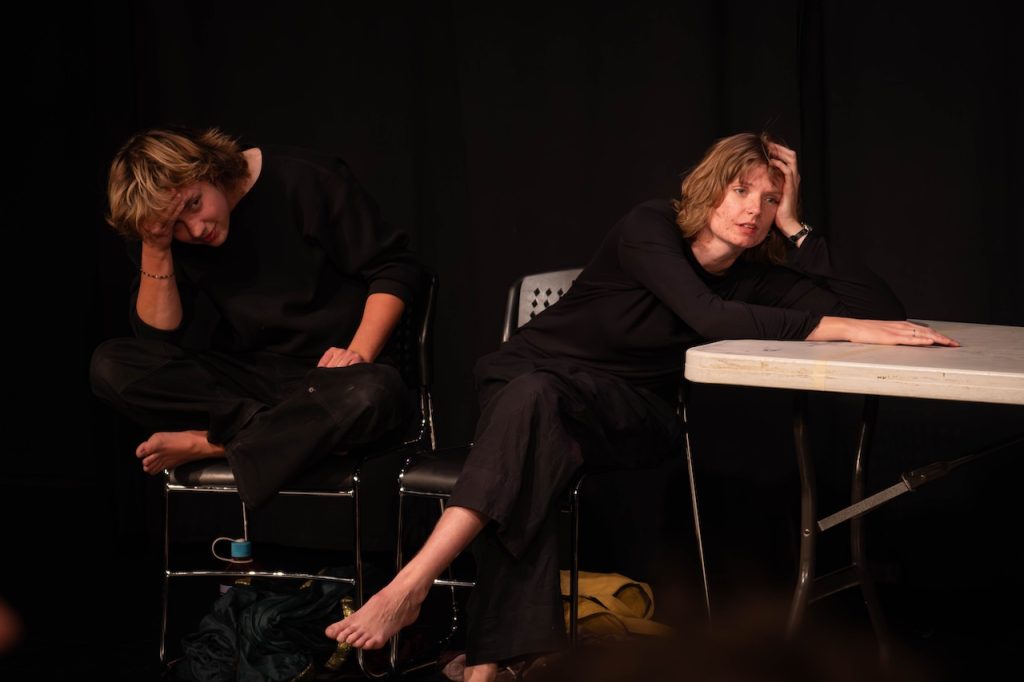
Based on Oedipus Rex by Sophocles, Oedipus, But Better retells the famous Greek tragedy about a man who murders his own fathers and sleeps with his own mother through a comedic lens. The show opens with the cast giving a fake introduction to the play, remarking on its absurdity and improvising a joke about their family members being in the audience. Oedipus, But Better not only echoes Oedipus Rex, but also The Play That Goes Wrong or Noises Off, other plays about making about theater. The actors did good work with this, managing to make their improvisation feel seamless enough that at no point was I as an audience member able to tell when they were on-or-off script, which is no easy feat.
Oedipus, But Better utilized a play-within-a-play structure, wherein we were both watching the actors attempt to put on Oedipus, and watching their performance of a play the actors play exaggerated versions of the characters from the tragedy, with some playing multiple characters. George Fortin ‘28 plays a himbo version of Oedipus who bumbles through riddles and tries to uncover the truth about the murder of the old king of Thebes, ending with a dramatic realization that he killed the king and that he was his father. Nikolai Suchman ’29 plays Tiresius, the blind Oracle of Thebes, who prophesies that Oedipus will kill his father and wed his mother with a laid-back demeanor that read like something out of a slacker comedy like The Big Lebowski, with robe and sunglasses to boot.
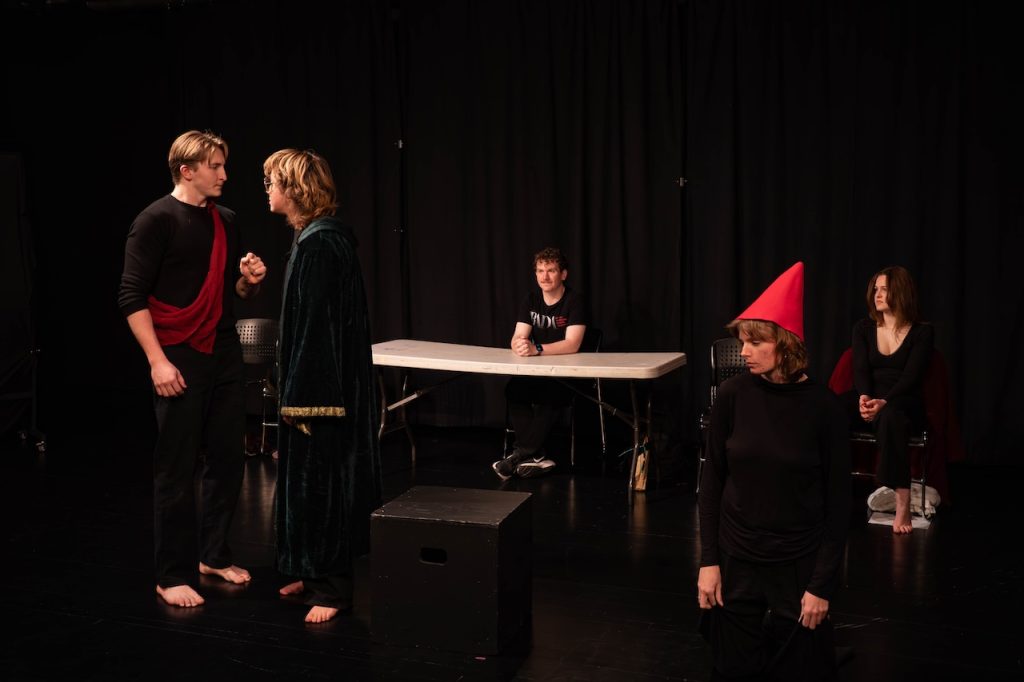
Grace Whitney ’29 is double cast as a very badly injured messenger (whose injury is mostly played for laughs), as well as Oedipus’s brother-in-law Creon, who serves as Oedipus’ confidant throughout the play. Willa Punches ’28 plays a motley of roles, switching between performing a musical number as the riddle-giving Sphinx, to the little boy accompanying Tiriesus, and then to Oedipus’s mother/wife, Jocasta, to whom she is desperately trying to add a layer of depth. The show does so by pausing time and forcing the characters to come up with a second named character for a second non-male character–in this case, Whitney becomes “Gloria Hole,” although this name is specific to my performance. Other nights featured other, equally vulgar, drag-esque names. The work this moment does is two-fold: for one thing, it points out the frequent underrepresentation of women in works such as Oedipus that are meant to represent humanity’s greatest questions of fatedness and belonging (as the play points out, “only that one scene in Henry V that is cut for time” passes of the first 3,000 years of theater). However, it also showcases the ways in which attempts to rectify these critiques of classic texts are haphazard. As Whitney generates the name “Gloria Hole,” she is attempting to apply a single band-aid to a millenia-long bullet hole.

The cast is rounded out by Ben Harris ’27 as the director, who tries to keep everything on track while reacting to the absurd actions of his cast and remarking on how obvious it is that Jocasta is Oedipus’s mother. The director seems to just want to put on a show, despite his actor’s near constant attempts to stage a production based coup-de-tat.
Oedipus, But Better attempts to follow the plot of the original Oedipus beat-for-beat, including all of the hit details: a man is told a prophecy that he simply does not want to be true, but cannot escape the fate of killing his father or sleeping with his mother. On its face this tale is one that is hard to make funny: patricide and incest are hardly knee-slappers. Thus, much of the comedy is born from the back-and-forth between the play-within-the-play and reality; for instance, there is a moment wherein the actors bicker about if they should just do Hamilton instead of Oedipus–after all, they still know all of the words. These moments, along with the ways in which the play-within-the-play is funny (it’s rare that you see a production of Oedipus that includes a song by the Sphinx), allows for a level of levity not usually afforded to Greek tragedies.
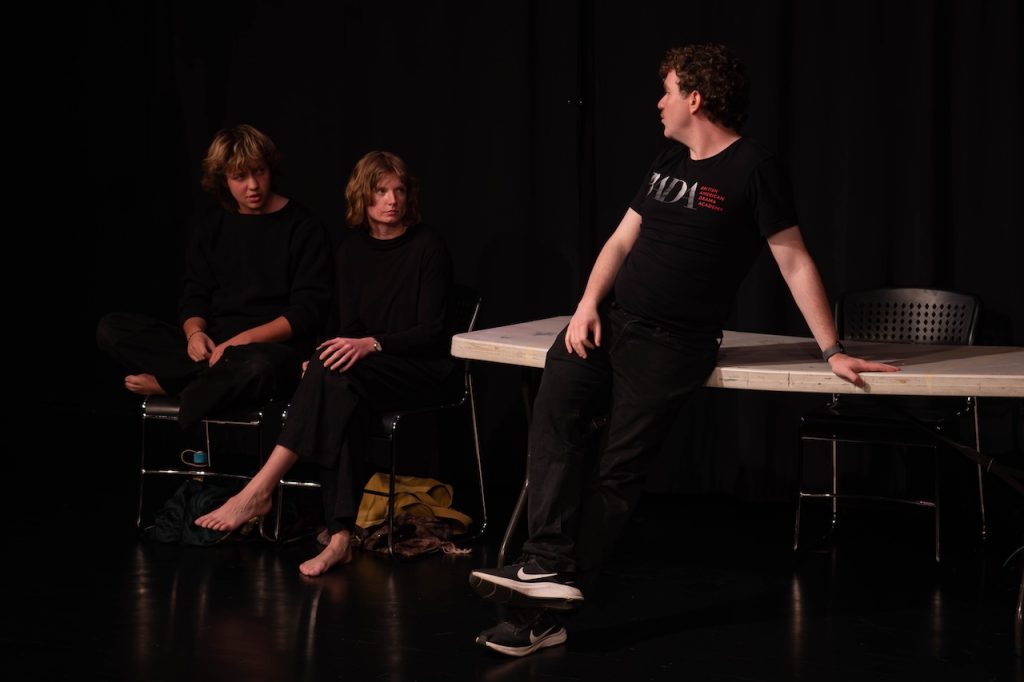
Altogether, thanks to a mix of Collin’s direction and the cast’s superb talent, Oedipus, But Better presents its audience with a comedic spin on a classic tragedy, creating a story that is both unique and familiar to those who have read the original play.
Photos by Camille Klingen ’28
***
Nate Lewis ’27 is a staff writer for the Skidmore Theater Living Newsletter